AES-256-GCM: A Developer's Implementation Guide
By Veilock Team · Veilock · Published July 29, 2026 · Updated August 28, 2026 · 18 min read

AES-256-GCM is an authenticated encryption with associated data (AEAD) construction that combines the AES-256 block cipher in Counter Mode for confidentiality with GHASH, a Galois field authenticator, for integrity. It delivers both encryption and authentication in a single pass. The single most important operational rule: never reuse a nonce under the same key. Nonce reuse does not merely weaken security — it destroys it, allowing an attacker to recover plaintext and forge authentication tags. Always verify the authentication tag before releasing any decrypted data to the application layer.
Table of Contents
- How does AES-256-GCM work under the hood?
- What parameters and limits must you follow?
- Security considerations and failure modes you need to know
- How to implement AES-256-GCM safely in production
- Performance characteristics and hardware acceleration
- AES-256-GCM vs. other AEADs: which one should you choose?
- Standards and RFCs that govern AES-256-GCM
- Key management for AES-256-GCM: generation, storage, and rotation
- Pre-deployment checklist for AES-256-GCM
- Key Takeaways
- The real lesson most developers miss about AES-256-GCM
- Veilock uses AES-256-GCM to protect your traffic end to end
- Authoritative references and further reading
How does AES-256-GCM work under the hood?
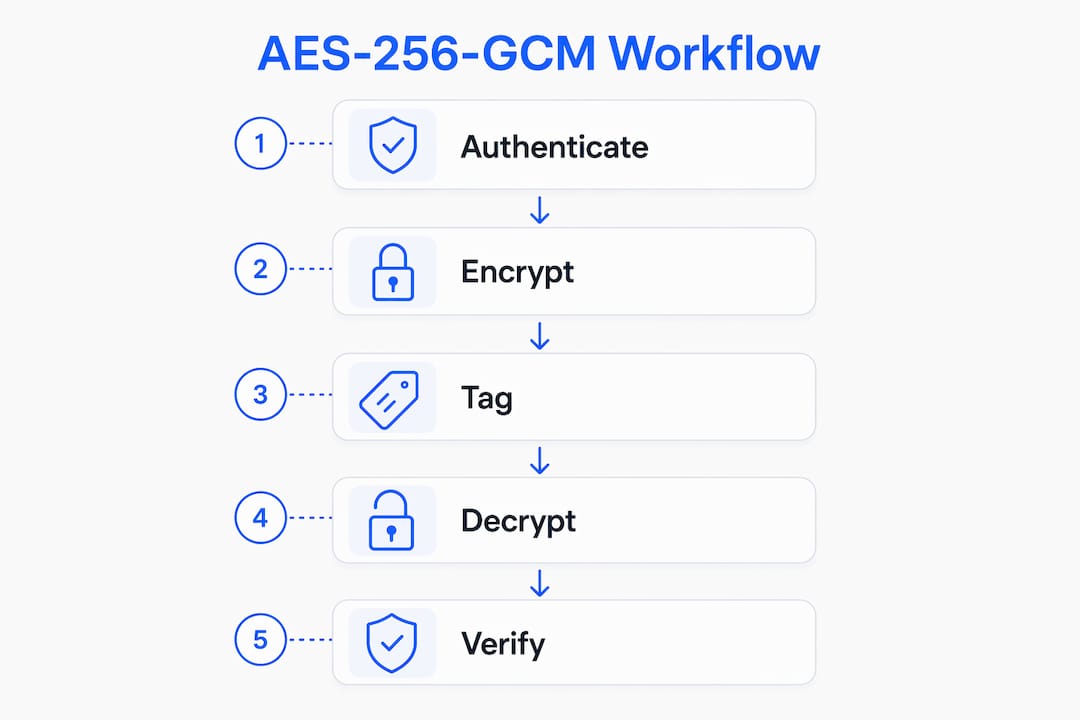
AES-256-GCM, standardized in NIST SP 800-38D, combines two distinct operations: CTR-mode encryption for confidentiality and GHASH-based authentication for integrity. Understanding both is necessary to implement the algorithm safely.
The encryption side works as follows:
- Key setup: AES-256 expands the 256-bit key into a schedule covering 14 rounds, producing the hash subkey H by encrypting a 128-bit zero block.
- Counter block generation: The 96-bit IV is padded to form the pre-counter block J0 (IV ∥ 0³¹ ∥ 1). The counter is then incremented for each 128-bit plaintext block.
- CTR encryption: Each plaintext block is XORed with the AES-encrypted counter block, producing ciphertext. The counter never repeats within one invocation.
- GHASH computation: GHASH processes the additional authenticated data (AAD) and the ciphertext together using Galois field multiplication over GF(2¹²⁸), producing an intermediate authentication value S.
- Tag generation: The final authentication tag T is computed by encrypting S with the counter block J0 under the key. The standard tag length is 128 bits.
- Output: The function returns the ciphertext C and tag T. Both are required for decryption.
Decryption reverses the CTR step, then recomputes the tag over the received ciphertext and AAD. The tag must be verified before any plaintext is returned. If verification fails, the implementation must discard all decrypted bytes and return only an error. Returning partial plaintext on a failed tag check is a critical vulnerability.
Where AAD fits: AAD covers data that must be authenticated but not encrypted — think packet headers, protocol version fields, or session identifiers. An attacker who modifies AAD will cause tag verification to fail, so the receiver knows the metadata was tampered with. If your protocol has no such metadata, passing an empty AAD is valid; what matters is consistency between sender and receiver.
What parameters and limits must you follow?
Getting the parameters right is not optional. The NIST SP 800-38D specification sets hard bounds, and violating them breaks the security proof.

| Parameter | Recommended value | Hard limit | Notes |
|---|---|---|---|
| IV/Nonce length | 96 bits (12 bytes) | 1 bit – 2⁶⁴ – 1 bits | 96-bit IVs avoid extra GHASH processing |
| Authentication tag length | 128 bits (16 bytes) | 32–128 bits (multiples of 8) | Shorter tags increase forgery probability |
| Plaintext length per invocation | Up to ~64 GB | 2³⁹ – 256 bits | Exceeding this violates the spec |
| Per-key data volume | Rekey before approximately 350 GB of data under one key (for ~16 KB messages) | Depends on message size | Libsodium guidance |
| Key length | 256 bits (32 bytes) | Fixed for AES-256-GCM | Do not truncate |
Nonce generation strategy: The libsodium documentation recommends generating a random initial nonce, then incrementing it for each subsequent message under the same key. This avoids the birthday-bound collision risk of purely random nonces in high-volume systems. With a 96-bit nonce space, random nonces become statistically risky after roughly 2³² messages under one key.
Tag length trade-offs: A 128-bit tag gives a forgery probability of 2⁻¹²⁸ per attempt. Truncating to 96 bits raises that to 2⁻⁹⁶, which is still strong but reduces the margin. Tags shorter than 96 bits require compensating controls and are generally inadvisable outside constrained protocols with strict message-count limits.
Rekeying triggers: Rekey when you approach the per-key data volume limit, after a fixed time window (e.g., 24 hours for long-running sessions), or after a configurable message count. Forgery probability grows with total blocks processed under one key, so calculating your specific threshold based on actual message sizes is more accurate than relying on a single fixed number.
Security considerations and failure modes you need to know
The security of AES-256-GCM is mathematically sound when used correctly. In practice, the failures are almost always operational.
Nonce reuse is catastrophic. GCM’s security relies on the algebraic properties of GHASH over GF(2¹²⁸). When two messages are encrypted with the same key and nonce, an attacker can XOR the two ciphertexts to cancel the keystream, recovering the XOR of the two plaintexts. Worse, the attacker can also recover the GHASH subkey H, which makes forging authentication tags for arbitrary messages straightforward. This is not a theoretical concern — real-world attacks have exploited nonce reuse in deployed systems.
Common failure modes to watch for:
- Nonce reuse across threads or nodes: A counter that is not atomically incremented in a multi-threaded service, or not coordinated across distributed nodes, will eventually repeat. This is the most common real-world mistake.
- Incorrect AAD handling: If the sender and receiver use different AAD values, tag verification fails. If AAD is silently dropped or changed between encrypt and decrypt, the system loses tamper detection on that metadata.
- Truncated tags without compensating controls: Accepting tags shorter than 96 bits without strict message-count limits and rate limiting on verification attempts opens forgery windows.
- Non-atomic tag verification: Some low-level APIs allow comparing tags byte-by-byte in a loop. A timing side-channel in that comparison leaks information about how many bytes matched, enabling an attacker to forge tags incrementally. Always use constant-time comparison functions.
- Returning plaintext on decryption failure: Any code path that returns decrypted bytes before tag verification completes is a vulnerability. The plaintext must be held in a temporary buffer and zeroed if verification fails.
- Hardware or API bugs: Certain older OpenSSL versions had edge cases in GCM tag handling. Pin to a known-good version and check your library’s security advisories.
Operational errors like nonce reuse and mismanaged rotation produce more real-world risk than cryptanalytic attacks for the vast majority of deployments. The math is solid; the implementation is where things go wrong.
How to implement AES-256-GCM safely in production
Library selection
Two libraries stand out for production use in the United States and globally: OpenSSL and libsodium.

OpenSSL provides EVP_aead_aes_256_gcm through its EVP interface. Use the EVP layer, not the low-level AES_* functions, which do not handle GCM correctly. Always call EVP_DecryptFinal_ex and check its return value — a non-zero return means tag verification passed. Never skip that check.
// Correct OpenSSL decryption pattern (simplified)
EVP_CIPHER_CTX *ctx = EVP_CIPHER_CTX_new();
EVP_DecryptInit_ex(ctx, EVP_aes_256_gcm(), NULL, key, iv);
EVP_CIPHER_CTX_ctrl(ctx, EVP_CTRL_GCM_SET_TAG, 16, tag);
EVP_DecryptUpdate(ctx, plaintext, &len, ciphertext, ciphertext_len);
int ret = EVP_DecryptFinal_ex(ctx, plaintext + len, &len);
// ret == 1: tag verified. ret <= 0: FAIL — discard plaintext.
libsodium wraps AES-256-GCM through crypto_aead_aes256gcm_encrypt and crypto_aead_aes256gcm_decrypt. Before calling either, check crypto_aead_aes256gcm_is_available() — libsodium requires hardware AES support (AES-NI or ARM crypto extensions) and will return an error on platforms without it. The combined-mode API appends the tag to the ciphertext automatically, reducing the chance of accidentally separating them.
// Libsodium: always check hardware availability first
if (crypto_aead_aes256gcm_is_available() == 0) {
    // Fall back to crypto_aead_chacha20poly1305_ietf_*
}
Libsodium explicitly warns that using AES-GCM safely outside TLS is tricky and recommends alternatives like AEGIS-256 or ChaCha20-Poly1305 when nonce uniqueness cannot be guaranteed or hardware acceleration is absent.
Nonce strategies
- Single-writer counter: A 96-bit counter stored atomically in shared memory, incremented with a compare-and-swap before each message. Simple and safe for single-process services.
- Per-direction key differentiation: Derive separate keys for each direction (client-to-server, server-to-client) using HKDF. Each direction then manages its own counter independently, eliminating cross-direction nonce collisions.
- Concatenated (fixed-prefix, counter) pattern: Reserve the high 32 bits for a node or session identifier and use the low 64 bits as a counter. This partitions the nonce space across nodes without coordination.
Pro Tip: In distributed systems where a global counter is impractical, derive a unique per-session key for each connection using HKDF or a similar KDF seeded with a shared secret and session-specific context. Each session then starts its counter at zero, making nonce uniqueness a local guarantee rather than a cluster-wide coordination problem.
Key insight for distributed deployments: The hardest part of AES-GCM in distributed systems is not the cryptography — it is ensuring that no two nodes ever encrypt under the same (key, nonce) pair. If you cannot guarantee that with a counter, switch to XChaCha20-Poly1305, which uses a 192-bit nonce large enough for random generation to be safe at any realistic message volume.
Common pitfalls with code examples
Wrong: reusing a static nonce
# NEVER do this
nonce = b'\x00' * 12
for message in messages:
    ciphertext = aes_gcm_encrypt(key, nonce, message)  # Same nonce every time
Correct: incrementing nonce
import os
nonce = bytearray(os.urandom(12))  # Random start
for message in messages:
    ciphertext = aes_gcm_encrypt(key, bytes(nonce), message)
    # Increment nonce as a 96-bit little-endian integer
    for i in range(12):
        nonce[i] = (nonce[i] + 1) & 0xFF
        if nonce[i] != 0:
            break
JavaScript and WebAssembly environments without native AES-NI access will run AES-256-GCM in software, which is significantly slower and may be vulnerable to cache-timing attacks. In those environments, prefer the Web Crypto API (crypto.subtle.encrypt with AES-GCM) which delegates to the browser’s native implementation, or use ChaCha20-Poly1305 via a library like libsodium.js.
Performance characteristics and hardware acceleration
AES-256-GCM throughput varies dramatically depending on whether hardware acceleration is available.
Software performance: AES-256 runs 14 rounds compared to 10 for AES-128, producing roughly a 40% CPU overhead in pure software implementations. On a modern server without AES-NI, that gap is real and measurable under load.
With hardware acceleration, the picture changes entirely:
- Intel AES-NI: Reduces per-round latency to single-digit CPU cycles. AES-256-GCM throughput on AES-NI hardware typically reaches multiple gigabits per second per core, making the 14-vs-10 round difference negligible in practice.
- ARMv8 crypto extensions: Provide equivalent acceleration on ARM-based servers (AWS Graviton, Apple Silicon). libsodium detects these automatically via
crypto_aead_aes256gcm_is_available(). - PCLMULQDQ instruction: Accelerates the GHASH polynomial multiplication on x86, which is the other potential bottleneck in GCM at high throughput.
Statistic: AES-256 carries approximately a 40% throughput penalty versus AES-128 in software — a cost that drops to near-zero on hardware with AES-NI or ARM crypto extensions.
Practical benchmarking advice:
- Measure with your actual message sizes, not synthetic block benchmarks. GCM overhead is partly fixed per message (tag computation), so small messages see proportionally higher overhead.
- Test with and without AES-NI explicitly disabled (
OPENSSL_ia32capenvironment variable) to understand your fallback performance. - For embedded or WASM targets where hardware acceleration is absent, benchmark ChaCha20-Poly1305 as a direct alternative before committing to AES-256-GCM.
Key-length choice should be driven by risk profile and compliance requirements, not by a belief that AES-128 is broken. Both are currently secure; AES-256 adds margin against speculative quantum attacks and satisfies certain regulatory frameworks (FIPS 140-3, NSA Suite B) that mandate 256-bit keys for sensitive data.
AES-256-GCM vs. other AEADs: which one should you choose?
| Scenario | Recommended AEAD | Reason |
|---|---|---|
| TLS 1.3 on AES-NI hardware | AES-256-GCM | Hardware-accelerated, standardized, low latency |
| Mobile app (no AES-NI guarantee) | ChaCha20-Poly1305 | Consistent software performance; safer random nonces |
| Distributed storage, hard to coordinate nonces | XChaCha20-Poly1305 | 192-bit nonce; random generation is safe at scale |
| High-security, post-quantum margin needed | AEGIS-256 | Stronger security bounds; libsodium support |
| VPN tunnel on modern server hardware | AES-256-GCM | Pairs well with AES-NI; used in TLS and WireGuard variants |
| WebAssembly / browser environment | ChaCha20-Poly1305 | No hardware AES in many WASM runtimes |
The nonce model is the deciding factor. AES-256-GCM requires strict 96-bit nonce uniqueness — a guarantee that is straightforward in single-writer systems but genuinely difficult across distributed nodes. XChaCha20-Poly1305 uses a 192-bit nonce, making random generation statistically safe even at high message volumes. If you cannot enforce nonce uniqueness or frequent rekeying, libsodium’s own documentation recommends XChaCha20-Poly1305 or AEGIS-256 instead.
Performance and portability: On any platform with AES-NI or ARM crypto extensions, AES-256-GCM is both fast and secure. On platforms without acceleration — older ARM chips, RISC-V, WASM — ChaCha20-Poly1305 delivers more consistent throughput and avoids cache-timing risks inherent in software AES. AES-NI and ARM crypto extensions materially change engineering decisions: if AES-NI is present, AES-256-GCM is the natural choice; absent it, prefer ChaCha20-Poly1305.
AEGIS-256 is worth considering for new systems where maximum security margin matters and libsodium support is acceptable. It has stronger security bounds than GCM and is less sensitive to nonce-reuse consequences, though it is not yet as widely deployed in protocols.
For VPN deployments specifically, AES-256-GCM is the dominant choice in TLS-based tunnels and is well-supported across VPN protocols including OpenVPN and IKEv2/IPsec. WireGuard uses ChaCha20-Poly1305 by design, prioritizing portability and simplicity over hardware-specific optimization.
Standards and RFCs that govern AES-256-GCM
Understanding which standards apply helps you implement correctly and cite the right documents in security audits.
- NIST SP 800-38D: The primary specification for GCM and GMAC. Defines the authenticated encryption and decryption algorithms, IV construction, GHASH, tag lengths, and uniqueness requirements. This is the document to cite in design reviews and compliance submissions.
- RFC 5116: Defines the AEAD interface abstraction and registers
AEAD_AES_128_GCM(numeric ID 1) andAEAD_AES_256_GCM(numeric ID 2) as standard algorithm identifiers. Specifies the 12-byte nonce and 16-byte tag as the canonical parameters for both. Protocol designers should use these identifiers for interoperability. - RFC 5288: Defines the AES-GCM cipher suites for TLS 1.2, including
TLS_RSA_WITH_AES_256_GCM_SHA384and related suites. Specifies how the TLS record layer constructs the nonce from the fixed IV and sequence number, which is a concrete example of a safe, deterministic nonce strategy. - RFC 8446 (TLS 1.3): Mandates AEAD-only cipher suites and includes
TLS_AES_256_GCM_SHA384as a required suite. TLS 1.3’s nonce construction XORs the sequence number with a per-direction IV, ensuring uniqueness without explicit nonce transmission.
Practical implications for protocol designers: TLS handles nonce construction automatically, which is why application developers using TLS rarely need to think about GCM nonces directly. When you implement AES-256-GCM at the application layer — outside TLS — you take on the full responsibility for nonce management that TLS handles for you. That is the core reason libsodium warns that application-level AES-GCM is easy to misuse.
AES-GCM is hardware-accelerated and chosen for low-latency, high-throughput secure channels in TLS deployments. Library defaults in OpenSSL and libsodium generally make the secure choice for tag length and nonce size when you use the high-level EVP or crypto_aead_* APIs.
Key management for AES-256-GCM: generation, storage, and rotation
Secure key management is where many otherwise-correct AES-256-GCM deployments fail. The algorithm is only as strong as the key lifecycle around it.
Key generation: Always use a cryptographically secure pseudorandom number generator (CSPRNG). In libsodium, call crypto_aead_aes256gcm_keygen(). In OpenSSL, use RAND_bytes() with a properly seeded entropy pool. Never derive keys from passwords directly without a proper KDF like Argon2id or PBKDF2 with sufficient iterations. The key must be 32 bytes (256 bits) exactly.
Key storage: Store keys in hardware security modules (HSMs) or OS-level keystores (macOS Keychain, Linux kernel keyring, Windows DPAPI) wherever possible. For software-only deployments, keep keys in memory only for the duration of use, zero the buffer immediately after, and avoid writing keys to disk in plaintext. Secrets management systems like HashiCorp Vault or AWS Secrets Manager are appropriate for server-side deployments. For device-level key storage considerations, a public laptop security checklist covers endpoint-specific controls worth reviewing alongside your key storage policy.
Rotation policy: Rekey before reaching the per-key data volume limit — rekeying before the ~350 GB threshold for typical message sizes bounds forgery probabilities in long-running services. Time-based rotation (e.g., every 24 hours for active sessions) provides an additional control independent of volume. Message-count-based triggers are useful when message sizes vary widely.
Interaction with nonce strategies: When you rotate a key, reset the nonce counter to zero (or generate a fresh random starting nonce). A nonce that was safe under the old key is not automatically safe under the new one — the uniqueness requirement is per (key, nonce) pair, not per nonce alone. Document this reset explicitly in your key rotation runbook.
Worth knowing: Automate key rotation using a secrets management system that supports versioned secrets (HashiCorp Vault’s key/value v2, AWS Secrets Manager rotation lambdas). Store the current key version alongside each encrypted record so decryption can select the correct key without requiring a synchronized cutover. This pattern avoids the common failure mode where a key rotation breaks decryption of records encrypted under the previous key.
Pre-deployment checklist for AES-256-GCM
Before shipping AES-256-GCM into production, run through these checks. Each item corresponds to a real failure mode described above.
- Nonce uniqueness strategy is defined and tested. Confirm whether you are using a counter, a random-start-then-increment pattern, or per-session derived keys. Test the atomic increment path under concurrent load.
- Tag verification is mandatory and enforced. Audit every decryption call site. Confirm that plaintext is never returned to the caller when tag verification fails. Check that the comparison is constant-time.
- Hardware acceleration is detected at startup. Call
crypto_aead_aes256gcm_is_available()(libsodium) or check OpenSSL’s engine capabilities. Define a fallback: either refuse to start on unsupported hardware or switch to ChaCha20-Poly1305 automatically. - Rekey triggers are implemented and tested. Verify that your service tracks bytes encrypted per key and triggers rotation before the per-key limit. Test the rotation path in staging, including nonce counter reset.
- Key storage meets your security policy. Confirm keys are not logged, not written to disk in plaintext, and zeroed from memory after use. Verify HSM or keystore integration if required by your compliance framework.
- AAD is consistent between encrypt and decrypt. Write a test that verifies decryption fails when AAD is modified. Confirm that empty AAD is handled identically on both sides when no metadata is present.
- Error handling does not leak information. Decryption failures must return a generic error. Timing of the error response must not vary based on how many tag bytes matched. Log failures for monitoring without exposing ciphertext or partial plaintext.
- Library versions are pinned and audited. Check OpenSSL or libsodium release notes for GCM-related security fixes. Pin to a known-good version and include library updates in your dependency review process.
Key Takeaways
AES-256-GCM provides strong authenticated encryption, but its security depends entirely on correct nonce management, mandatory tag verification, and proactive rekeying before per-key data limits.
| Point | Details |
|---|---|
| Nonce uniqueness is non-negotiable | Reusing a nonce under the same key destroys both confidentiality and integrity; use atomic counters or per-session derived keys. |
| Always verify the tag first | Never return plaintext to the caller before tag verification passes; use constant-time comparison to avoid timing side-channels. |
| Rekey before volume limits | Rekey before approximately 350 GB of data under one key (for ~16 KB messages) to keep forgery probabilities bounded. |
| Choose based on hardware and nonce control | AES-256-GCM is the right choice on AES-NI hardware with strict nonce control; prefer ChaCha20-Poly1305 or XChaCha20-Poly1305 where those conditions do not hold. |
| Veilock uses AES-256-GCM with secure key handling | Veilock deploys AES-256-GCM in its VPN stack with hardware acceleration and a strict no-logs policy, so your traffic keys are never stored or exposed. |
The real lesson most developers miss about AES-256-GCM
There is a persistent assumption in the developer community that choosing a strong algorithm is the hard part. Pick AES-256-GCM, ship it, done. The algorithm is secure, so the system is secure. That reasoning is wrong, and the consequences are serious.
The cryptographic strength of AES-256-GCM is not in question. What the algorithm cannot protect against is the operational environment around it. A 256-bit key with a reused nonce is weaker than a 128-bit key with correct nonce management. A correctly encrypted message that returns plaintext before tag verification is a vulnerability regardless of key length. These are not edge cases — they are the actual failure modes that appear in real security audits and CVE disclosures.
The other underappreciated point is the hardware dependency. AES-256-GCM’s performance advantage over ChaCha20-Poly1305 exists only on hardware with AES-NI or ARM crypto extensions. On platforms without acceleration, software AES is not just slower — it can be vulnerable to cache-timing attacks that leak key material. Choosing AES-256-GCM for a WASM deployment or an older embedded target without verifying hardware support is a mistake that benchmarks alone will not catch.
The practical takeaway: treat algorithm selection as the starting point, not the finish line. Nonce strategy, key rotation, tag verification, and library version management are where the actual security work happens. AES-256-GCM is an excellent choice for the right environment. Knowing precisely when that environment applies is what separates a secure deployment from a vulnerable one.
Veilock uses AES-256-GCM to protect your traffic end to end
Veilock’s VPN stack deploys AES-256-GCM with hardware acceleration and proper nonce handling across its global server network. Every connection benefits from the same AEAD construction described in this article — encryption and authentication in a single pass, with no plaintext ever stored or logged. The no-logs policy means your traffic keys are never retained, which is the operational complement to strong cryptography: the algorithm protects data in transit; the policy protects it at rest.
For developers and security-conscious users who want a turnkey deployment of AES-256-GCM without managing nonce strategies or key rotation themselves, Veilock handles that infrastructure. Plans start at $4.46/month. Review the full VPN features and use cases to confirm Veilock fits your threat model before subscribing. Choose any solution — including Veilock — based on your specific security requirements, not marketing claims.
Authoritative references and further reading
These are the primary sources you should cite in design documents, security audits, and implementation reviews.
- NIST SP 800-38D: The definitive GCM specification. Required reading for anyone implementing or auditing AES-GCM. Covers GHASH, IV construction, tag lengths, and uniqueness requirements in full mathematical detail.
- FIPS 197 (AES): The AES block cipher specification. Documents the 14-round structure of AES-256 and the key expansion algorithm.
- RFC 5116: Defines the AEAD interface and registers
AEAD_AES_256_GCM. Essential for protocol designers who need standard algorithm identifiers. - RFC 5288: AES-GCM cipher suites for TLS 1.2. Shows a concrete, standards-compliant nonce construction strategy.
- Libsodium AES-256-GCM documentation: Practical API reference with nonce guidance, hardware availability checks, and explicit recommendations on when to use alternatives. The most developer-friendly starting point for implementation.
- GCM specification (NIST/CSRC): The original GCM proposal with full GHASH mathematical derivation. Useful for understanding the security proof and forgery bounds.
- Encryption on macOS platforms: Platform-specific guidance on how macOS exposes hardware AES acceleration and keychain-based key storage, relevant for developers targeting Apple environments.
Related reading on Veilock
About the author
Veilock Team · Veilock