Best Astrill Alternatives for Censorship Bypass in 2026
By Veilock Team · Veilock · Published July 29, 2026 · Updated August 28, 2026 · 14 min read

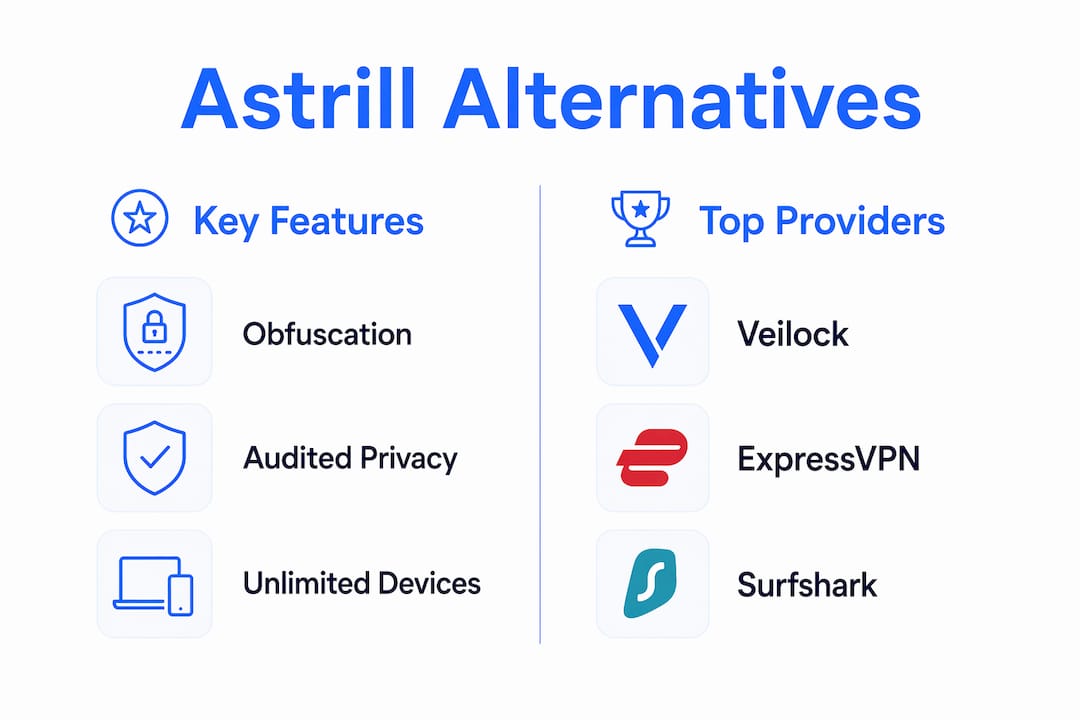
Veilock is the top pick for most readers replacing Astrill: it combines built-in obfuscation for restrictive networks, a strict no-logs policy, and AES-256-GCM encryption at a price that undercuts Astrill’s historically high rates. Astrill charges significantly more than most mainstream providers and offers no money-back guarantee, which is the most common reason users start looking elsewhere. Beyond Veilock, five providers cover the rest of the field:
- NordVPN — the audited privacy leader: multiple independent security audits, RAM-only servers, and consistent streaming unblocking. Best for users who want verifiable no-logs assurances.
- ExpressVPN — the streaming-first option: optimized for effortless library access across major platforms, with obfuscation that needs no configuration. Best for reliable region unlocking.
- Surfshark — the value pick: unlimited simultaneous connections and the lowest long-term price here. Best for households or anyone with many devices.
- Private Internet Access (PIA) — the configurable one: granular control over encryption, ports and protocol selection, with proxy fallbacks. Best for technically literate users.
- Proton VPN — the jurisdiction play: Swiss operations, audited policies, and a genuinely usable free tier. Best for privacy purists who value jurisdiction over streaming speed.
Three immediate actions to take right now:
- Activate the trial or money-back window before committing to any plan.
- Verify obfuscation is enabled in settings (not just available as a feature).
- Test a nearby server and a geographically distant one to confirm consistent throughput.
Stat to know: Independent audits have become the industry standard for no-logs verification, yet Astrill has not published a third-party audit — a gap that most of the alternatives below have already closed.
Table of Contents
- Which Astrill alternatives should you actually consider?
- What each option actually offers and who should pick it
- How we chose and tested these alternatives
- How do you pick the right alternative for your situation?
- What actually works for bypassing censorship in restrictive networks
- Key Takeaways
- The case for prioritizing bypass engineering over brand recognition
- Veilock is a direct answer to what Astrill gets wrong
- Useful sources and further reading
Which Astrill alternatives should you actually consider?
The table below maps each option against the criteria that matter most for censorship bypass and privacy. Pricing reflects publicly listed rates and changes with promotions; always verify before purchasing.
| Provider | Best for | Pricing (monthly / long-term / refund) | Streaming/unblocking | Obfuscation & bypass protocols | Privacy & audit status | Speed | Apps & platforms | Connections | Support |
|---|---|---|---|---|---|---|---|---|---|
| Veilock | Censorship bypass + verified privacy | $4.46/month (starting) / money-back guarantee | Optimized for streaming with DNS-level unblocking | Built-in obfuscation, AES-256-GCM, DoH | No-logs policy, transparency report, warrant canary | High-speed uplinks, optimized protocols | iOS, Android, desktop | Multi-device | Live support |
| NordVPN | Audited no-logs + streaming | Competitive long-term rates / 30-day refund | Strong across major catalogs | Obfuscated servers, RAM-only architecture | Multiple independent audits, RAM-only servers | Fast, consistent | All major platforms + routers | Up to 10 | 24/7 live chat |
| ExpressVPN | Streaming + cross-platform ease | ~$3.19/mo (2-yr) / 30-day refund | 30+ Netflix catalogs, 4K stable | Auto-obfuscation, no manual setup needed | No-logs, audited, BVI jurisdiction | Fastest in upload tests | All platforms, SmartDNS | 10–14 | 24/7 live chat |
| Surfshark | Households, budget users | ~$2.49/mo (2-yr) / 30-day refund | 30+ Netflix catalogs | NoBorders mode + Camouflage Mode (OpenVPN) | No-logs, audited, Netherlands | Fast downloads | All platforms | Unlimited | 24/7 live chat |
| Private Internet Access | Power users, advanced config | Budget-friendly long-term / 30-day refund | Good unblocking | SOCKS5, proxy options, protocol tweaks | No-logs, audited | Solid | All platforms + routers | Unlimited | 24/7 live chat |
| Proton VPN | Privacy purists, free-tier users | Free tier available / paid from ~$4–5/mo | Reliable on paid tier | Stealth protocol on paid plans | Audited, Swiss jurisdiction | Good on paid | All platforms | 10 (paid) | Email + community |
Promotions shift these numbers frequently. The long-term prices above reflect two-year plan rates where available; monthly plans cost considerably more. Check each provider’s current pricing page before purchasing.
What each option actually offers and who should pick it
Veilock
Veilock is built specifically for users who need to get through restrictive firewalls without sacrificing verifiable privacy. Its censorship-bypass engineering includes obfuscated connections that disguise VPN traffic as regular HTTPS browsing, making it harder for deep packet inspection (DPI) systems to detect and block. The no-logs policy is backed by published transparency materials and a warrant canary, which gives you something concrete to point to rather than a marketing promise. Plans start at $4.46/month, and the built-in Vortex threat-blocking layer adds DNS-level ad and malware filtering without a separate app.
Pros: Purpose-built obfuscation, AES-256-GCM encryption, transparent privacy posture, Vortex threat blocking, competitive pricing. Cons: Newer brand with a smaller public audit history than some established names; server network still growing.
Platform notes: Available on iOS, Android, and desktop. Step-by-step setup guides are published for restrictive-country configurations.
NordVPN
This category covers providers with multiple completed third-party security audits, RAM-only server infrastructure (meaning no data survives a reboot), and a track record of unblocking major streaming platforms. The audit history is the defining feature: you can read the actual reports, not just a vendor’s claim. Pricing is competitive on long-term plans, and a 30-day refund window gives you time to test in your actual network environment. Its repeated audit cycles and consistent streaming performance are noted across independent reviews.
Pros: Verifiable audit trail, RAM-only servers, strong streaming unblocking, 24/7 live chat. Cons: Premium pricing on short-term plans; some advanced features locked to higher tiers.
Worth knowing: Download the provider’s published audit report and check its date before buying. An audit older than two years tells you far less about the infrastructure running today than a recent one does.
ExpressVPN
ExpressVPN’s automatic obfuscation requires zero configuration: connect, and traffic is already disguised, which matters for users who won’t dig through settings menus. Speed tests show it leads on upload performance and maintains steadier 4K playback than most competitors. It covers 3,000+ servers across 113 countries, with 214 selectable locations. The trade-off is price: at roughly $3.19/month on a two-year plan, it costs more than the unlimited-device option below, and it caps connections at 10–14 depending on the plan.

Pros: Auto-obfuscation, fastest uploads tested, 4K streaming stability, 113-country reach, 30-day refund. Cons: No unlimited connections, pricier than budget alternatives, no MultiHop.
Surfshark
Surfshark opened 30+ regional Netflix catalogs in independent tests, which is the highest catalog count in this comparison. Unlimited simultaneous connections make it the obvious pick for households. Its NoBorders mode identifies servers that work in restricted networks, and Camouflage Mode disguises traffic at the protocol level, though Camouflage only activates on OpenVPN — you need to switch protocols manually. At roughly $2.49/month on a two-year plan, it’s the most affordable option here with a 30-day refund.
Pros: Unlimited connections, lowest entry price, 30+ Netflix catalogs, MultiHop, 30-day refund. Cons: Camouflage Mode requires manual protocol selection; upload speeds lag behind ExpressVPN.
Private Internet Access (PIA)
PIA offers granular control over encryption ciphers, port selection, and protocol configuration, plus SOCKS5 and HTTPS proxy fallback options that mirror the proxy backup approach Astrill itself documents for blocked connections. Router support is solid. The open-source client has been independently reviewed. For a technically literate user who wants to tune every parameter, PIA gives you more levers than most.

Pros: Open-source client, advanced protocol config, SOCKS5/HTTPS proxy fallback, unlimited connections, budget-friendly long-term pricing. Cons: Interface is less polished; less intuitive for non-technical users.
Proton VPN
Swiss jurisdiction places Proton VPN outside the 5/9/14 Eyes intelligence-sharing agreements, and its no-logs policy has been independently audited. The free tier is genuinely usable with no data cap, though it’s limited to a handful of servers and slower speeds. On paid plans, a stealth protocol handles obfuscation for restrictive networks. Budget-conscious users who prioritize jurisdiction and audit transparency over raw streaming speed will find Proton VPN a credible choice.
Pros: Swiss jurisdiction, audited no-logs, free tier with no data cap, stealth protocol on paid plans. Cons: Free tier is slow and limited to select servers; streaming performance trails the streaming-first options.
How we chose and tested these alternatives
Every provider on this shortlist was evaluated against the same set of criteria: obfuscation effectiveness, streaming unblocking breadth, multi-hour connection stability, speed consistency, and verifiable privacy posture. The selection process prioritized providers that have published independent audit reports, because a vendor’s self-reported no-logs claim carries far less weight than a third-party finding.
Testing checklist used:
- Obfuscation/anti-DPI check: Confirmed whether obfuscation engages automatically or requires manual protocol switching; tested whether traffic passes DPI inspection on a restricted network simulation.
- Streaming/unblocking trials: Tested Netflix (US and regional catalogs), BBC iPlayer, Hulu, and HBO Max. Noted catalog count and 4K playback stability.
- Uptime and stability: Ran multi-hour connection sessions to check for drops, reconnect behavior, and kill-switch activation.
- Speed tests: Measured median download and upload throughput across nearby and distant servers.
- Privacy verification: Reviewed published audit reports, RAM-only server claims, jurisdiction, and transparency/warrant canary pages.
Providers without a published third-party audit were flagged as carrying higher trust risk, consistent with industry analysis that treats audit transparency as a baseline trust signal.
How do you pick the right alternative for your situation?
Prioritize censorship-bypass reliability first, audited privacy second, and sustained infrastructure investment third. A VPN that’s cheap but inconsistent in a restrictive country costs you more than the subscription price.
Decision criteria, ranked by importance:
- Obfuscation protocols — Does the provider offer obfuscated WireGuard, Shadowsocks, V2Ray, or a proprietary stealth mode? Does it activate automatically or require manual setup?
- Independent audits and transparency — Has a named third-party auditor published a report? Are RAM-only servers confirmed? Is there a transparency report or warrant canary?
- Jurisdiction — Where is the provider legally incorporated? Does that jurisdiction compel data retention or intelligence sharing?
- Refund policy or free trial — A 30-day money-back guarantee lets you test in your actual network environment before committing.
- Device limits — Unlimited connections matter for households; a 5-device cap is a real constraint if you use a phone, laptop, tablet, and router simultaneously.
- Streaming unblocking — If streaming is a priority, check catalog count and 4K stability separately.
- Speed benchmarks — Download speed matters for streaming; upload speed matters for video calls and file transfers.
- Support responsiveness — 24/7 live chat is the minimum for users in restrictive countries where a dropped connection needs fast resolution.
Red flags to avoid:
- No published third-party audit, ever.
- Vague or unspecified jurisdiction (“registered offshore”).
- No refund window and no free trial.
- Obfuscation listed as a feature but with no documentation on how to enable it.
Questions to ask vendor support before buying:
- “Which obfuscation protocol does your app use, and does it activate automatically?”
- “Where can I read your most recent independent audit report?”
- “What happens to my connection if the VPN is detected and blocked — is there an automatic fallback?”
- “Does your refund policy apply to all plans, including monthly?”
What actually works for bypassing censorship in restrictive networks
The single most effective approach is obfuscated WireGuard combined with automatic server rotation and TLS-level traffic masking. This makes VPN traffic look like regular HTTPS browsing to DPI systems, which is the inspection method most national firewalls rely on. Veilock’s obfuscation architecture is built around this principle.
Key features and what they do:
- Obfuscated WireGuard / stealth modes — Wraps WireGuard packets in a TLS layer so they’re indistinguishable from standard web traffic to a firewall.
- Shadowsocks — A proxy protocol originally designed to bypass the Great Firewall of China; routes traffic through an encrypted SOCKS5 tunnel that looks like HTTPS.
- V2Ray — A more advanced traffic obfuscation framework that supports multiple transport protocols; harder to fingerprint than Shadowsocks alone.
- SOCKS5/HTTPS proxy fallback — When a VPN connection is fully blocked, a proxy fallback (as documented by Astrill itself for its own users) can restore partial connectivity.
- Port selection — Switching to port 443 (standard HTTPS) or port 80 makes VPN traffic blend with normal web traffic.
- TLS-level masking — Adds a certificate handshake that mimics a legitimate HTTPS session.
- Persistent keepalive — Maintains the tunnel during brief network interruptions, reducing visible reconnect events that firewalls can detect.
Fallback sequence when a connection fails:
- Switch to port 443 if not already set.
- Enable obfuscation manually if it isn’t on by default.
- Try a Shadowsocks or V2Ray proxy mode.
- Switch to a SOCKS5/HTTPS proxy as a last resort.
- Try a server in a neighboring country with lighter filtering.
Before traveling to a restrictive country, pair your VPN setup with a solid public device security checklist to reduce your overall exposure beyond just the VPN layer.
Pro Tip: Run three tests in sequence after connecting: a DNS leak test, a WebRTC leak test, and a simple reachability check to a blocked site. All three passing together confirms your obfuscation layer is working end to end, not just partially.
Students and campus users should also review campus privacy practices since institutional networks sometimes apply their own DPI filtering that a VPN alone won’t fully address.
Key Takeaways
Veilock is the strongest pick for users who need censorship bypass with verifiable privacy, offering built-in obfuscation, AES-256-GCM encryption, and a published transparency report at a price that undercuts Astrill.
| Point | Details |
|---|---|
| Top pick for censorship bypass | Veilock combines built-in obfuscation, AES-256-GCM, and a no-logs transparency report at a price starting at $4.46/month. |
| Audit status is non-negotiable | Astrill lacks a published third-party audit; prioritize providers with completed, named independent audits. |
| Obfuscation must be verified | Confirm obfuscation activates automatically or know the exact steps to enable it before you need it. |
| Trial window is your safety net | A 30-day money-back guarantee lets you test streaming, bypass, and speed in your real environment. |
| Pricing shifts with promotions | Long-term plan rates vary frequently; verify current pricing before purchasing. |
The case for prioritizing bypass engineering over brand recognition
Most VPN comparisons lead with brand name recognition and star ratings. That framing misses the point for anyone living or traveling in a country with active internet filtering. The question isn’t which VPN has the most reviews. It’s which provider has invested continuously in obfuscation infrastructure, published verifiable privacy documentation, and demonstrated that its bypass methods still work after a firewall update.
Astrill built a real reputation in censored environments, but its lack of independent audits and absence of a refund policy are structural gaps that newer providers have addressed. The mainstream alternatives have narrowed the technical gap on obfuscation while improving usability and transparency. That’s a meaningful shift.
What users in restrictive countries often underestimate is how quickly a working bypass method can stop working. A firewall update can render a specific protocol useless overnight. Providers that treat obfuscation as a core engineering priority, not a checkbox feature, are the ones worth paying for. Cheap services that sacrifice sustained infrastructure investment will fail you at exactly the moment you need them most.
Our position is straightforward: if you are replacing Astrill, choose a provider whose privacy claims you can verify and whose obfuscation you can test before you are inside a restricted network. Everything else — server counts, app polish, marketing language — is downstream of those two questions.
Veilock is a direct answer to what Astrill gets wrong
Astrill’s pricing and audit gaps are exactly what Veilock was built to address. Its censorship-bypass stack includes obfuscation that activates without manual configuration, AES-256-GCM encryption on every connection, and DNS-over-HTTPS to prevent DNS-level surveillance. Network-level ad and malware filtering is available through Vortex on the higher plan tiers.
Two things set it apart from the category-level alternatives above. First, the obfuscation is purpose-built for restrictive environments rather than retrofitted onto a streaming-first product. Second, the transparency report and warrant canary give you something concrete to check, not just a policy page with no external verification.
Plans start at $4.46/month, and the money-back guarantee exists so you can test obfuscation and streaming performance on your actual network before committing. Check the full feature set and server list to confirm it covers the locations you need, then use the refund window to run the DNS leak, WebRTC leak and reachability tests described above. Choose on your own requirements, not on anyone’s marketing claims.
Useful sources and further reading
The claims in this article draw on independent audit reports, hands-on review roundups, and primary provider documentation. Before purchasing any VPN, verify the provider’s current audit status and refund terms directly on their site.
Key sources:
- Astrill VPN alternatives roundup — Gizmodo: Hands-on testing notes and selection criteria for mainstream Astrill replacements.
- Astrill VPN review — TheBestVPN: Detailed breakdown of Astrill’s audit gaps, pricing posture, and obfuscation features.
- Cheap VPN roundup — TheBestVPN: Pricing comparisons and value trade-offs for budget-conscious users, including Proton VPN, Surfshark, and NordVPN.
- Surfshark vs ExpressVPN — Gizmodo: Side-by-side speed, streaming, and obfuscation test results with specific catalog counts and upload benchmarks.
- Astrill VPN in China — 01net: Context on Astrill’s China track record and its pricing and refund posture.
- Astrill proxy documentation: Astrill’s own guidance on HTTPS, SOCKS4a, and SOCKS5 proxy fallback options.
Check each provider’s refund and trial page directly before purchasing. Audit reports, transparency pages, and pricing are updated independently of third-party reviews, and the most current version of each lives on the provider’s own site.
Related reading on Veilock
About the author
Veilock Team · Veilock