Domain Fronting Explained: Techniques, Risks, and Defenses
By Veilock Team · Veilock · Published August 5, 2026 · Updated August 28, 2026 · 18 min read

Quick answer
Domain fronting hides a connection's true destination by exploiting a mismatch between the TLS SNI field, which network observers can see, and the HTTP Host header, which is encrypted inside the tunnel. It was a genuine censorship-circumvention breakthrough in 2015, but Cloudflare, AWS, Google and Microsoft have since disabled or restricted it, so it is no longer dependable.
Domain fronting hides a connection’s true destination by exploiting a mismatch between the TLS SNI field (visible to network observers) and the HTTP Host header (encrypted inside the tunnel). It was a genuine censorship-circumvention breakthrough when first documented in the PETS 2015 paper by Fifield et al., but today it is largely unreliable: Cloudflare, AWS, Google, and Microsoft have all disabled or restricted it on their infrastructure.
For defenders: watch for SNI/Host header mismatches in your TLS inspection logs, and treat any such mismatch as a triage priority.
For users seeking censorship resistance: skip ad-hoc fronting attempts and use a purpose-built obfuscated VPN or Tor with bridges instead. The technique’s original strategic advantage, that censors feared blocking a major CDN would cause collateral damage to legitimate services, no longer holds when the CDN itself enforces consistency.
- Domain fronting is cataloged under MITRE ATT&CK T1090.004 as an adversary proxy technique.
- Classic fronting is disabled on AWS CloudFront, Google Cloud CDN, Microsoft Azure CDN, and Cloudflare.
- Obfuscated VPNs with AES-256-GCM encryption and audited no-logs policies are the practical replacement for circumvention use cases.
- Defenders without full TLS inspection should layer JA3/JA3S fingerprinting and traffic-pattern anomaly detection as partial signals.
How does domain fronting work at the protocol level?
The technique depends on a structural feature of how HTTPS traffic flows through a CDN. Understanding it requires separating three distinct places where a domain name appears in a connection.
Where domain names live in a connection
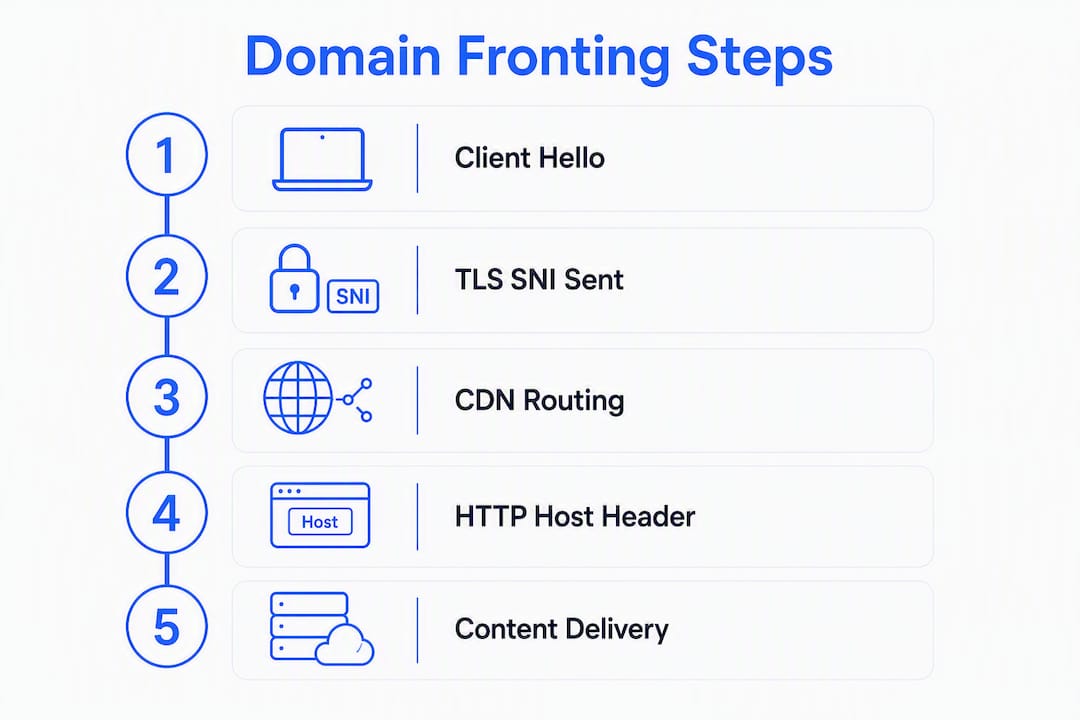
When your browser connects to a website over HTTPS, the domain name appears in at least two separate locations. First, it appears in the DNS query, which is typically unencrypted. Second, it appears in the TLS ClientHello as the Server Name Indication (SNI) field. SNI is sent in cleartext before the TLS handshake completes, so any network observer, including a firewall or government censor, can read it. Third, once the TLS session is established and all traffic is encrypted, the HTTP request contains a Host header that tells the server which virtual host to serve.

The critical insight from the PETS 2015 research is that these two fields do not have to match. A CDN edge server terminates TLS based on the SNI, but then routes the decrypted HTTP request to an origin server based on the Host header. If both the front domain and the covert destination share the same CDN provider, the edge server will happily forward the request to the covert origin.
The connection sequence, step by step
- DNS lookup: The client resolves the front domain (e.g., a popular, benign CDN customer). The DNS response returns a CDN edge IP address.
- TCP connection: The client opens a TCP connection to that CDN edge IP.
- TLS ClientHello with SNI: The client sends a TLS ClientHello containing the front domain in the SNI field. Network observers see only the front domain.
- TLS handshake completes: The CDN edge presents a certificate for the front domain and establishes an encrypted session.
- HTTP request inside TLS: The client sends an HTTP GET or POST with a Host header pointing to the covert destination (e.g., a C2 server or a blocked service). This header is encrypted and invisible to passive observers.
- CDN routes on Host header: The CDN edge reads the Host header, performs an origin-pull to the covert destination, and returns the response through the same encrypted session.
The technique breaks the moment a CDN enforces strict binding between the SNI and the Host header. AWS CloudFront, for example, now returns an error when those two values do not correspond to the same distribution. Some CDN configurations historically allowed fronting, while others enforced consistency from the start.
Key protocol terms
| Term | What it means |
|---|---|
| SNI (Server Name Indication) | A TLS extension that tells the server which certificate to present; sent in cleartext before encryption begins. |
| HTTP Host header | An HTTP header inside the encrypted tunnel that identifies the target virtual host or origin. |
| CDN edge server | A geographically distributed server that terminates TLS and forwards requests to origin servers on behalf of CDN customers. |
| TLS handshake | The protocol exchange that establishes an encrypted session, including certificate validation and key agreement. |
| ESNI / Encrypted Client Hello (ECH) | A TLS extension that encrypts the SNI field itself, making SNI-based detection harder. Zscaler notes that ECH has both privacy-enhancing and potentially abuseable implications for defenders. |
Why domain fronting rose and why major CDNs shut it down
The timeline from research to provider response
The technique was formally described in the 2015 PETS paper by David Fifield and colleagues, who built it into Meek, a Tor pluggable transport. Meek used Google App Engine and Amazon CloudFront as front domains, routing traffic to Tor bridges while appearing to connect to Google or Amazon infrastructure. Lantern and Psiphon adopted similar approaches for their own circumvention networks.
The strategic logic was elegant. Censors in countries like China, Iran, and Russia faced a genuine dilemma: blocking the CDN IP ranges or domains used for fronting would also block every other service on that CDN. That collateral damage risk, disrupting Google, Amazon, or Microsoft services for millions of users, made aggressive blocking politically and economically costly. This collateral-damage dynamic was the core of why the technique worked as well as it did.
The provider responses came in sequence:
- Google (2018): Disabled the App Engine behavior that allowed fronting, citing terms-of-service violations and abuse concerns. Tor’s Meek-Google transport stopped working.
- Amazon Web Services (2018): Updated CloudFront to enforce SNI/Host consistency, breaking fronting configurations that relied on CloudFront distributions.
- Microsoft Azure (2018–2019): Implemented similar enforcement on Azure CDN, closing the vector for configurations that relied on Azure-hosted front domains.
- Cloudflare: Enforced strict hostname validation at the edge, preventing Host headers from routing to origins outside the authenticated customer’s account.
Major providers have disabled or limited domain fronting across their infrastructures, making classic fronting unreliable at scale. The policy rationale was consistent across all four: the same mechanism that helped activists also helped attackers hide command-and-control (C2) traffic inside legitimate CDN traffic.
The technique did not disappear entirely
Security researchers continue to find edge-case vectors inside complex cloud-native routing configurations. Certain CDN features, multi-tenant routing tables, wildcard certificates, and misconfigured origin-pull rules, can recreate similar behavior in modified forms. Defenders should not treat the 2018 provider actions as a permanent closure.
What are the legitimate and malicious uses of domain fronting?
The same protocol trick served radically different purposes depending on who was using it. The table below maps each use case to its detectability, current viability, risk profile, and recommended alternative.
| Use case | Category | Detectability | Current viability | Legal/ethical risk | Recommended alternative |
|---|---|---|---|---|---|
| Tor Meek transport (censorship bypass) | Legitimate circumvention | Hard without TLS inspection | Largely disabled on major CDNs | Low in U.S.; varies by country | Tor with obfs4 bridges |
| Psiphon / Lantern circumvention | Legitimate circumvention | Hard without TLS inspection | Partially functional on some CDNs | Low in U.S.; varies by country | Obfuscated VPN or Tor |
| Humanitarian / journalist access | Legitimate circumvention | Hard without TLS inspection | Unreliable; CDN-dependent | Low in U.S. | Managed obfuscated VPN |
| C2 traffic hiding (malware) | Malicious abuse | Moderate with JA3 + anomaly detection | Still attempted; harder post-2018 | High; criminal exposure | N/A (attacker use case) |
| Data exfiltration via CDN | Malicious abuse | Moderate with full TLS inspection | Still attempted in targeted attacks | High; criminal exposure | N/A (attacker use case) |
| Red-team / penetration testing | Security research | Moderate with TLS inspection | Possible in lab/authorized scope | Low if authorized; high if not | Authorized test environment |
MITRE ATT&CK catalogs domain fronting as T1090.004 under the Proxy technique family, specifically in the context of adversary C2 evasion. Real-world attacker use has included APT groups routing C2 callbacks through CDN infrastructure to blend with normal HTTPS traffic, making the traffic appear to originate from a trusted cloud provider rather than a suspicious IP.
The circumvention use cases, Tor’s Meek transport being the most documented, were genuinely effective for activists and journalists in heavily censored environments. The problem was that the technique was architecturally identical whether the user was a human rights worker or a threat actor. That symmetry is precisely why providers ultimately chose policy enforcement over selective allowlisting.
How can defenders detect domain fronting in their networks?
Detection is possible but not trivial. The core signal is a mismatch between the SNI field and the HTTP Host header, but reading both requires either full TLS inspection or a cloud-based Secure Web Gateway (SWG) that performs inspection at scale.
Detection checklist
- SNI vs. Host header comparison: Log both fields for all HTTPS sessions. A mismatch where the SNI points to a major CDN domain but the Host header resolves to an unrelated or internal destination is a high-confidence indicator.
- Full TLS inspection (inline): Deploy an inline TLS inspection proxy or a cloud SWG that decrypts, inspects, and re-encrypts traffic. This is the only method that reliably exposes the Host header.
- JA3/JA3S fingerprinting: JA3 hashes the TLS ClientHello parameters to create a fingerprint of the client. Known fronting tools and malware families have documented JA3 signatures. JA3S fingerprints the server response. Neither is definitive alone, but both are useful as corroborating signals.
- Traffic-pattern anomaly detection: Look for unusual request volumes, low-entropy payloads in encrypted flows, or abrupt changes in destination patterns from a single endpoint. Automated anomaly detection can surface these patterns without requiring full decryption.
- ESNI/ECH monitoring: Encrypted Client Hello hides the SNI field entirely. A sudden spike in ECH-enabled connections from endpoints that do not normally use it warrants investigation.
- Account and IP correlation: Cross-reference CDN traffic with known CDN customer account data. Traffic routing to a CDN origin that does not correspond to any registered customer account is anomalous.
Practical limitations you need to know
Full TLS inspection is the gold standard, but it introduces real tradeoffs. Certificate pinning in mobile apps and some desktop clients will break under inspection, generating false positives and user complaints. Inspecting encrypted traffic also raises privacy concerns for employees and requires clear policy disclosure. Performance overhead from decryption at scale can be significant without purpose-built hardware or a cloud SWG.
Where TLS inspection is impractical, multi-signal detection is the fallback: account and IP correlation, unusual request patterns, spikes in encrypted but low-entropy flows, and abrupt changes in destination Host headers observed in decrypted telemetry all contribute to a composite picture.
Pro Tip: Prioritize TLS inspection for traffic destined to CDN IP ranges from endpoints classified as high-risk (servers, privileged workstations, or endpoints with recent alert history). Inspecting all traffic uniformly is expensive; inspecting the right traffic is tractable.
Response playbook
- Triage: Confirm the SNI/Host mismatch is not a known-good application behavior (some legitimate apps use CDN configurations that superficially resemble fronting).
- Containment: Block the specific SNI domain or CDN IP range at the perimeter while investigation continues. Avoid broad CDN blocks that cause collateral damage to unrelated services.
- Endpoint investigation: Pivot to the originating endpoint. Check for malware, unauthorized tools, or red-team artifacts. Correlate with EDR telemetry.
- Policy update: Add the confirmed front domain to a blocklist or tighten allowlist rules. Update SWG policy to flag future mismatches from the same CDN range.
- Escalation: If C2 activity is confirmed, escalate to incident response and preserve forensic artifacts before containment actions destroy evidence.
How have CDN providers and enterprises mitigated domain fronting?
Vendor-side engineering and policy changes
The provider responses after 2018 were both policy and engineering. On the policy side, AWS, Google, Microsoft, and Cloudflare each updated their terms of service to explicitly prohibit using their infrastructure to obscure traffic destinations. On the engineering side, they implemented validation logic at the edge that compares the SNI presented during the TLS handshake with the Host header in the decrypted HTTP request. When those values do not correspond to the same CDN customer account or distribution, the edge server returns an error rather than forwarding the request.
This enforcement is not universal across every CDN or every configuration. Smaller CDN providers and misconfigured deployments of major CDNs can still exhibit the behavior. Praetorian’s research demonstrates that cloud-native routing quirks can revive similar vectors, which is why defenders cannot rely solely on the assumption that major CDN policy changes solved the problem permanently.
Enterprise best practices
Deploy a cloud SWG with TLS inspection. A cloud-based SWG that performs large-scale TLS inspection and includes a dedicated “Block Domain Fronting” enforcement policy is the most direct enterprise control. Zscaler’s analysis recommends this approach specifically for detecting SNI/Host mismatches at scale.
Monitor SNI and Host header fields. Even without inline decryption, logging SNI fields from TLS ClientHello messages and correlating them with DNS query logs can surface suspicious patterns. Pair this with DNS-layer controls to catch DNS-based evasion alongside CDN-based fronting.

Use certificate and application classification. Classify CDN certificates by provider and flag any session where the certificate’s Subject Alternative Names do not include the Host header value observed in decrypted traffic.
Balance blocking with business continuity. Broad CDN blocks remain a poor choice. The same collateral-damage dynamic that protected fronting from censors also protects it from blunt enterprise blocking. Targeted, account-level or distribution-level blocks are more precise and less disruptive.
What are the safer alternatives for users who need censorship resistance?
If you were relying on domain fronting for circumvention, the practical reality is that the technique is no longer dependable. The alternatives below are purpose-built, actively maintained, and do not depend on CDN policy gaps that providers can close overnight.
Comparing your main options
Tor with obfs4 bridges remains one of the strongest options for high-risk users. The obfs4 pluggable transport obfuscates Tor traffic so it does not look like Tor, and bridges are unlisted relays that censors cannot easily block by IP. The tradeoff is speed: Tor’s multi-hop routing adds latency that makes it unsuitable for video streaming or latency-sensitive applications.
Obfuscated VPNs using WireGuard or OpenVPN with obfuscation layers offer a better balance of speed and censorship resistance for most users. WireGuard’s modern cryptographic design combined with an obfuscation wrapper (such as obfs4 or a proprietary obfuscation protocol) produces traffic that looks like ordinary HTTPS to deep packet inspection systems. This is the approach used by production-grade commercial VPNs designed for restricted markets.
Managed, audited commercial VPNs add operational reliability, customer support, and verified no-logs policies on top of the technical stack. For travelers, remote workers, and organizations operating in restricted markets, a managed VPN removes the configuration burden and provides a clear accountability chain.
Checklist for choosing a censorship-bypass tool
- Obfuscation support: Does the tool actively disguise VPN traffic as ordinary HTTPS? Without this, deep packet inspection in countries like China or Iran will identify and block the connection.
- Encryption standard: Look for AES-256-GCM or an equivalent authenticated encryption scheme. This is the current standard for secure tunnel encryption.
- No-logs policy: A verified, independently audited no-logs policy protects you if the provider receives a legal demand. Unaudited claims are not equivalent.
- Jurisdiction: Where is the provider incorporated? Providers in jurisdictions with strong privacy law and no mandatory data-retention requirements offer stronger legal protection.
- Protocol options: Support for multiple protocols (WireGuard, OpenVPN, and a proprietary obfuscated protocol) gives you fallback options when one is blocked.
- Audit history: Has the provider’s infrastructure and no-logs policy been independently audited? Published audit reports are a meaningful trust signal.
- Client ease-of-use: A technically sound tool that requires manual configuration is a liability in a high-stress situation. Prefer tools with polished clients for the platforms you actually use.
U.S.-focused legal guidance
Domain fronting is not categorically illegal in the United States, but provider terms of service typically prohibit it, and its association with malicious C2 activity creates real account-termination and legal exposure risk for users who attempt it on commercial CDNs. Using a legitimate, commercially available obfuscated VPN carries none of those risks for U.S.-based users. The legal picture changes significantly for users in countries where VPN use itself is restricted; if you are operating in such a jurisdiction, consult local legal counsel before deploying any circumvention tool.
This article provides general information, not legal advice. Confirm current rules with a qualified attorney or the relevant primary source for your jurisdiction.
Why obfuscated VPNs are the production-grade replacement for domain fronting
The core problem with domain fronting as a circumvention method was always its fragility. It depended on a CDN policy gap that providers could close unilaterally, and they did. Obfuscated VPNs with audited no-logs policies are the recommended replacement precisely because they are purpose-built for the job, not exploiting an unintended side effect of CDN architecture.
Veilock is one example of this approach. The table below maps the needs that originally drove domain fronting adoption to the features a managed obfuscated VPN provides.
Disclosure: Veilock is the publisher of this article. The comparison below reflects Veilock’s own feature set.
| Circumvention need | How a managed obfuscated VPN addresses it |
|---|---|
| Hide traffic from deep packet inspection | Obfuscated connections disguise VPN traffic as ordinary HTTPS, passing DPI filters used in restrictive countries. |
| Strong encryption for sensitive communications | AES-256-GCM encryption provides authenticated encryption resistant to interception and tampering. |
| No activity logs that could be subpoenaed | A strict no-logs policy, independently verifiable, means no stored connection records to hand over. |
| Access to blocked services from multiple devices | Global server network with high-speed uplinks and multi-device support covers travelers, remote teams, and activists across platforms. |
| DNS privacy alongside traffic obfuscation | DNS-over-HTTPS (DoH) encrypts DNS queries so ISPs and censors cannot read your lookup history even before the VPN tunnel is established. |
| Network-level threat blocking | Vortex threat blocking filters malware, ads, and malicious domains at the network level, adding a layer of protection beyond traffic obfuscation. |
Use-case guidance: Travelers passing through countries with aggressive DPI benefit most from obfuscated connections combined with a no-logs policy. Journalists and activists in restricted markets need the combination of obfuscation, strong encryption, and a provider with a verifiable no-logs commitment. Remote teams operating across restricted markets benefit from the multi-device support and enterprise-grade secure access that a managed VPN provides. Tor with obfs4 bridges remains the better choice when anonymity is the primary concern and latency is acceptable; a managed VPN is the better choice when reliability, speed, and ease of use matter more.
Key Takeaways
Domain fronting exploits the SNI/Host header mismatch inside CDN infrastructure, but major providers have closed this vector, making obfuscated VPNs the reliable replacement for both circumvention users and security-conscious organizations.
| Point | Details |
|---|---|
| Core mechanism | Domain fronting mismatches the TLS SNI (visible) and HTTP Host header (encrypted) to route traffic covertly through a CDN edge. |
| Current viability | Cloudflare, AWS, Google, and Microsoft have all disabled or restricted classic domain fronting on their infrastructure. |
| MITRE ATT&CK mapping | The technique is cataloged as T1090.004 and is associated with adversary C2 evasion and data exfiltration. |
| Detection priority | Full TLS inspection or a cloud SWG is required to reliably compare SNI and Host headers; JA3 fingerprinting and anomaly detection serve as partial signals without decryption. |
| Veilock as alternative | Veilock’s obfuscated VPN with AES-256-GCM encryption and a verified no-logs policy is a production-grade replacement for circumvention use cases where domain fronting is no longer viable. |
The ethical line between circumvention research and enabling harm
The security community’s relationship with domain fronting is genuinely complicated, and the easy framing, “good for activists, bad for attackers,” obscures a harder truth. The technique is architecturally neutral. The same CDN routing behavior that helped a journalist in Tehran reach blocked news sites also helped a threat actor hide C2 callbacks inside Google infrastructure. Providers did not shut it down because activists were using it. They shut it down because the abuse cases were indistinguishable from the legitimate ones at the infrastructure level.
That symmetry should inform how researchers and operators approach similar techniques. Publishing a working fronting implementation without coordinating with the affected CDN provider does not just help the people you intend to help. It hands the same tool to everyone who reads the writeup. Responsible disclosure, coordinating with providers before publishing, and scoping research to authorized environments, is not bureaucratic caution. It is the practical difference between advancing defensive knowledge and creating a new attack surface.
For defenders, the lesson from domain fronting’s history is that behavior-based detection outlasts signature-based detection. The specific SNI/Host mismatch pattern is largely gone from major CDNs, but the underlying behavior, hiding a covert destination inside traffic that appears to go somewhere trusted, will keep appearing in new forms. Focusing detection on behavioral anomalies and account correlation, rather than only on known signatures, is what keeps your detection posture relevant as techniques evolve.
Ethical guidance for researchers and operators:
- Conduct fronting tests only in authorized environments with explicit written permission from the CDN or network owner.
- Coordinate with CDN providers before publishing new fronting vectors; give them time to patch before public disclosure.
- Do not publish working proof-of-concept code for fronting techniques without a clear defensive framing and a coordinated disclosure timeline.
- If you discover a new fronting vector in a production CDN, treat it as a vulnerability report, not a blog post opportunity.
- Consult legal counsel before testing fronting techniques in jurisdictions where unauthorized computer access laws are broadly written.
Veilock: a purpose-built alternative for censorship bypass
If this article confirmed that domain fronting is no longer a reliable path, the next question is what actually works. Veilock was built specifically to answer that question for individuals and teams operating in restricted environments.
Where domain fronting depended on CDN policy gaps that providers could close overnight, Veilock’s censorship-bypass architecture is purpose-built and actively maintained. Obfuscated connections make your VPN traffic look like ordinary HTTPS to deep packet inspection systems, including the Great Firewall of China. AES-256-GCM encryption protects everything inside the tunnel. A strict no-logs policy means there is nothing to hand over if a legal demand arrives. Plans start at $4.46/month, and Vortex threat blocking adds network-level malware and ad filtering on top of the core VPN.
Veilock is the publisher of this article. Evaluate it against your own legal and operational requirements before subscribing.
See Veilock’s full feature set and decide whether a managed obfuscated VPN fits your situation better than the alternatives this article covered.
Useful sources and further reading
The claims in this article draw on the following primary and authoritative sources. Each is worth reading directly if you want to go deeper on a specific aspect of domain fronting.
-
Blocking-resistant communication through domain fronting — (Fifield et al., PETS 2015): The foundational academic paper. Covers the original mechanism, the collateral-damage strategic rationale, and early deployment in Tor’s Meek transport. Supports the technical mechanics and history sections of this article.
-
MITRE ATT&CK — Proxy: Domain Fronting (T1090.004) — The authoritative adversary technique catalog entry. Covers C2 use cases, detection guidance, and mitigation references. Supports the use-cases and detection sections.
-
Domain fronting — Wikipedia — Accessible overview covering history, provider responses, and U.S. legal framing. Supports the legal guidance in the alternatives section.
-
ArXiv — CDN routing and domain fronting analysis: Academic measurement study on domain name misinformation and CDN routing behavior. Supports the technical mechanics section on edge-server routing and SNI/Host binding.
Related reading on Veilock
- DNS-over-HTTPS (DoH) Explained: Stop DNS Leaks in 2026
- Types of DDoS Attacks | Veilock
- DNS Hijacking Fix: Stop the Attack and Secure Your Network
- Doxxing: What It Is and How to Protect Yourself | Veilock
- VPN Obfuscation: How Stealth Connections Work
- Internet Censorship: How It Works | Veilock
- How to Set Up Stunnel for Bypass | Veilock
- What Is Deep Packet Inspection (DPI)? | Veilock
About the author
Veilock Team · Veilock