ExpressVPN Alternatives: Best Picks for Privacy & Bypass
By Veilock Team · Veilock · Published August 5, 2026 · Updated August 28, 2026 · 14 min read

Quick answer
If you need a VPN that pushes through deep packet inspection and national firewalls, Veilock is the strongest starting point. NordVPN and CyberGhost are the most consistent for streaming, Surfshark wins on device limits, Proton VPN leads on verifiable privacy, and Private Internet Access suits torrenters who want fine-grained control.
If you need a VPN that can push through deep packet inspection (DPI) and national firewalls, Veilock is the strongest starting point among the alternatives covered here. For streaming-first users, NordVPN and CyberGhost are the most consistent performers. Surfshark wins on device limits. Proton VPN leads on verifiable privacy. Private Internet Access suits torrenters who want fine-grained control. PrivadoVPN offers a usable free tier for light testing.
Here is the shortlist at a glance:
- Veilock — Best for censorship-bypass, activists, and expats. Obfuscated connections, Vortex threat blocking, AES-256-GCM encryption, strict no-logs. Plans start at a moderate monthly price.
- NordVPN — Best for speed and advanced security features. Specialty servers, strong unblocking, well-audited. Pricier on monthly plans.
- Surfshark — Best for households or teams needing unlimited simultaneous connections. Competitive pricing.
- Proton VPN — Best for privacy purists. Swiss jurisdiction, open-source apps, independently audited no-logs policy.
- CyberGhost — Best for streaming ease of use. Streaming-optimized servers, beginner-friendly apps.
- Private Internet Access (PIA) — Best for torrenters and power users. Port forwarding, highly configurable.
- PrivadoVPN — Best free-tier entry point. Data-capped free plan; useful for UI testing only.
Pro Tip: Before committing to any provider, use its money-back guarantee to test performance on your actual ISP and location. Local network conditions, not lab benchmarks, determine whether a VPN works for you. A verified refund policy is your safety net.
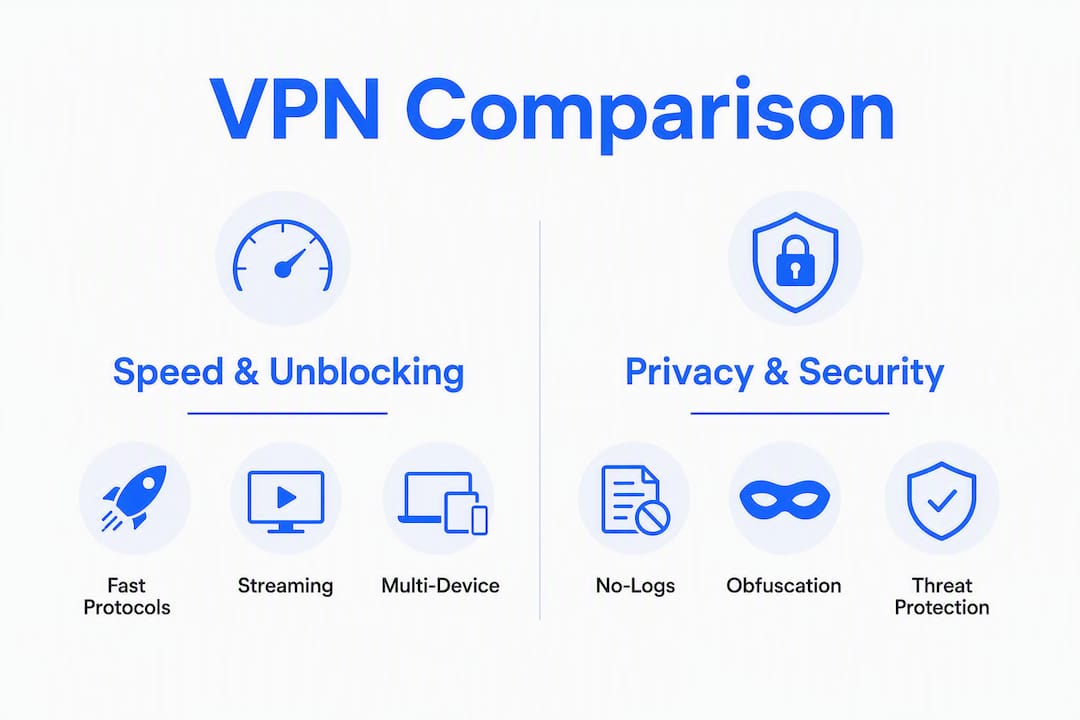
How do these ExpressVPN alternatives compare at a glance?
| Provider | Speed / Performance | Price (best-value plan) | Privacy & Audits | Streaming & Torrenting | Obfuscation / Censorship-Bypass | Simultaneous Connections | Key Extras | Money-Back / Free Tier |
|---|---|---|---|---|---|---|---|---|
| Veilock | High-speed uplinks, optimized for bypass | From $4.46/mo | Strict no-logs, AES-256-GCM, DNS-over-HTTPS | Streaming-optimized; P2P supported | Yes — obfuscated modes, DPI-resistant | Multi-device support | Vortex threat blocking, split tunneling, kill switch | Money-back guarantee |
| NordVPN | Consistently fast; NordLynx (WireGuard-based) | ~$3–4/mo (2-yr plan) | Audited no-logs; Panama jurisdiction | Excellent unblocking; P2P servers | Obfuscated servers available | 10 devices | Threat Protection, specialty servers | 30-day money-back |
| Surfshark | Fast; WireGuard support | ~$2–3/mo (2-yr plan) | Audited no-logs; Netherlands | Strong unblocking; P2P supported | Camouflage & NoBorders modes | Unlimited | CleanWeb ad/malware blocking, split tunneling | 30-day money-back |
| Proton VPN | Good; WireGuard & OpenVPN | Free tier; paid from ~$4/mo | Swiss jurisdiction; open-source; audited | Good unblocking; P2P on paid plans | Stealth protocol | 10 devices (paid) | NetShield ad blocker, Secure Core | Free tier + 30-day money-back |
| CyberGhost | Solid; WireGuard support | ~$2–3/mo (2-yr plan) | Audited no-logs; Romania | Streaming-optimized servers; P2P servers | Limited obfuscation | 7 devices | Dedicated streaming/torrenting servers | 45-day money-back |
| Private Internet Access | Good; WireGuard & OpenVPN | ~$2/mo (3-yr plan) | Audited no-logs; US jurisdiction | Good unblocking; strong P2P/port forwarding | MACE + obfuscation options | Unlimited | Port forwarding, MACE ad blocker | 30-day money-back |
| PrivadoVPN | Adequate on paid; throttled on free | Free tier; paid from ~$2/mo | No-logs policy; Switzerland | Limited on free tier | Limited | 10 devices (paid) | Basic ad blocking | 30-day money-back (paid) |
A few points worth noting after scanning that table:
- Server count is not a reliable proxy for censorship performance. Providers with fewer but strategically engineered servers and active IP rotation can outperform large networks in high-censorship environments. Veilock’s design prioritizes this.
- Obfuscation quality varies significantly. “Obfuscated servers available” does not mean the same thing across providers. Test the specific obfuscated mode in your target country before committing.
- Free tiers are useful for testing the interface, not for evaluating real-world throughput or bypass reliability. Data caps and speed limits make them unsuitable for continuous or high-stakes use.
To interpret this table: start with the streaming column if unblocking is your priority, the obfuscation column if you are in a restricted network, and the privacy/audits column if you are a journalist, activist, or expat who cannot afford a logging incident.
Which provider is the right fit for your needs?
Veilock
Purpose-built for users who cannot afford a failed connection: activists, expats, remote workers in countries with aggressive DPI filtering, and anyone who needs a VPN that treats censorship-bypass as a primary engineering goal rather than a checkbox feature. Its obfuscated connection modes make traffic look like regular HTTPS browsing, which is what gets past the Great Firewall of China and similar systems. AES-256-GCM encryption and DNS-over-HTTPS (DoH) are standard across plans. The Vortex threat-blocking layer handles ad, malware, and tracker filtering at the network level, so you do not need a separate browser extension.

Strengths: Censorship-bypass engineering as a core design goal; strict no-logs policy; Vortex threat blocking; plans from $4.46/month.
Trade-offs: Newer brand with a smaller public track record than NordVPN or Proton VPN; independent audit publication is a trust signal to watch for as the service matures.
Best for: Users in restricted countries, expats, activists, and privacy-first users who want integrated threat blocking.
NordVPN
NordVPN is the most frequently cited top ExpressVPN competitor in comparative roundups, and the performance data backs that reputation. Its NordLynx protocol (built on WireGuard) delivers some of the fastest real-world speeds in the category. Specialty servers include obfuscated, double-VPN, and Onion-over-VPN options. The no-logs policy has been independently audited multiple times, and the Panama jurisdiction keeps it outside 14-Eyes data-sharing agreements.

Strengths: Audited no-logs; fast NordLynx protocol; strong unblocking; 10 simultaneous connections; Threat Protection feature.
Trade-offs: Monthly pricing is high; the 2-year plan is where value appears. The US-facing app has had occasional UI complaints.
Best for: Users who want a well-established, fast, feature-rich service with a proven audit record.
Surfshark
Surfshark’s unlimited simultaneous connections make it the practical choice for households or small teams. Camouflage Mode strips VPN metadata so the connection looks like standard traffic, and NoBorders Mode activates automatically in restrictive regions. CleanWeb blocks ads and malware at the DNS level. The 2-year plan pricing is among the lowest in the premium tier.
Strengths: Unlimited devices; competitive pricing; Camouflage and NoBorders obfuscation modes; audited no-logs.
Trade-offs: Netherlands jurisdiction (EU data retention laws apply to the company, though the no-logs policy is audited). Speed can vary more than NordVPN on distant servers.
Best for: Families, teams, or budget-conscious users who need multiple devices covered without paying per seat.
Proton VPN
Proton VPN is the clearest choice when verifiable privacy is the deciding factor. Swiss jurisdiction places it outside EU and US legal reach. Its apps are open-source and independently audited, which means the no-logs claim is not just marketing copy. The Stealth protocol handles obfuscation for restrictive networks. The free tier has no data cap, which is unusual, though speeds are limited and server selection is restricted.
Strengths: Swiss jurisdiction; open-source, audited apps; Secure Core multi-hop routing; free tier with no data cap.
Trade-offs: Free tier is slow and limited to a handful of servers. Paid pricing is mid-range but not the cheapest. Streaming performance is good but not as consistent as NordVPN or CyberGhost on every platform.
Best for: Privacy purists, journalists, and researchers who need a fully audited, open-source client with a credible jurisdiction.
CyberGhost
CyberGhost’s streaming-optimized servers are its clearest differentiator. The app labels servers by the specific streaming platform they unblock, which removes guesswork for users who just want Netflix, Disney+, or BBC iPlayer to work. Setup is straightforward, and the 45-day money-back guarantee is the longest in this group, giving you more time to test. Editorial reviews consistently note its ease of use as a standout quality.
Strengths: Streaming-optimized servers labeled by platform; 45-day money-back guarantee; beginner-friendly apps; Romania jurisdiction.
Trade-offs: Obfuscation is limited compared to NordVPN or Veilock. Not the strongest choice for high-censorship environments.
Best for: Streaming-first users who want a simple setup and the longest trial window in the category.
Private Internet Access
PIA is the most configurable option in this group. Port forwarding support makes it the go-to for torrenters who need to seed efficiently. You can toggle encryption level, protocol, and connection settings in ways most consumer VPNs do not expose. The no-logs policy has been audited and court-tested. Unlimited simultaneous connections and a very low 3-year plan price add to the value case.
Strengths: Port forwarding; highly configurable; audited no-logs; unlimited connections; low long-term pricing.
Trade-offs: US jurisdiction is a concern for some privacy users, even with an audited no-logs policy. The interface can feel complex for non-technical users.
Best for: Torrenters and advanced users who want maximum control over their connection settings.
PrivadoVPN
PrivadoVPN’s free tier is its main draw. Swiss jurisdiction and a stated no-logs policy give it a credible privacy posture on paper. The free plan imposes a data cap, which makes it unsuitable for streaming or continuous use. It is a reasonable way to test the interface before deciding whether to pay, but free tiers rarely reflect real-world performance. Use the paid plan under the money-back guarantee for any serious evaluation.
Best for: Users who want a low-commitment entry point to test a VPN interface before committing to a paid plan.
Worth knowing: When comparing providers, check whether the “no-logs” claim is backed by a published third-party audit. Independent audits and transparency reports are stronger privacy signals than marketing statements alone.
How do you choose the right ExpressVPN alternative?
The right choice depends on which failure mode you are most trying to avoid. Here is a practical decision sequence:
- Check jurisdiction and audit status — For high-stakes privacy needs, prioritize providers with published third-party audits and a jurisdiction outside 14-Eyes. Swiss (Proton VPN, PrivadoVPN) and Panama (NordVPN) are the strongest options here.
Document your trial tests: note the server location, protocol, and speed result for each test. If you need a refund, this log makes the support conversation faster and cleaner.
How were these VPNs evaluated?
The recommendations in this article are based on a structured review of real-world performance signals, published audit records, and editorial consensus from authoritative sources including PCMag and CNET.
Streaming and unblocking checks covered Netflix, Disney+, BBC iPlayer, and HBO Max using servers in the US, UK, and EU. Speed assessments drew on published test data from multiple regions rather than single-point benchmarks, because ISP and routing conditions vary enough to make any single figure misleading. Censorship-resistance checks focused on obfuscation mode availability, IP rotation design, and documented bypass success in high-DPI environments.
On privacy signals: CNET’s 2026 VPN coverage notes that independent audits and published transparency reports are stronger privacy indicators than marketing “no-logs” statements. Every provider in this list was evaluated against that standard.
For censorship environments specifically, raw server count was not treated as a meaningful metric. A provider with 200 strategically engineered, actively rotated servers can outperform one with 5,000 static IPs in a country with aggressive DPI filtering. What matters is obfuscation quality, IP rotation frequency, and how quickly the provider responds when IPs get blocked.
Its architecture is relevant here because censorship-bypass is the primary engineering focus, not a secondary feature. Its obfuscated connection modes are designed to resist DPI at the protocol level, and the Vortex threat-blocking layer adds a layer of protection that most providers charge extra for or do not offer at all.
Refund policies were verified by checking each provider’s published terms. Money-back guarantee windows range from 30 days (NordVPN, Surfshark, PIA, Veilock, Proton VPN) to 45 days (CyberGhost).
Bottom line: In censorship-heavy environments, a successful connection rate in your specific country matters more than total server count. Ask the provider’s support team directly whether their obfuscation mode has documented success in your target country before you buy.
Which alternative should you try first?
Match your scenario to the recommended starting point:
- You stream Netflix, Disney+, or BBC iPlayer regularly → Try CyberGhost first. Use the 45-day window to test the platform-labeled servers for your specific services.
- You are in a country with active DPI filtering or a national firewall → Try Veilock first. Enable obfuscated mode immediately and test a connection to a site that is blocked in your country.
- Privacy and audit transparency are your top priorities → Try Proton VPN. Review the published audit report and test the Stealth protocol if you are in a restricted region.
- You need to cover 6+ devices or a whole household → Try Surfshark. Confirm the NoBorders mode works on your network if you are in a restricted country.
- You torrent regularly and want port forwarding → Try Private Internet Access. Configure port forwarding during the trial and verify seeding speeds.
- You want the best overall speed and feature set → Try NordVPN. Test NordLynx on your local ISP and compare it to your current provider.
- You want a free entry point with no data cap → Try Proton VPN’s free tier, then upgrade to a paid plan under the money-back guarantee for a realistic performance test.
For switching safely: export your current VPN’s settings or note your preferred server locations before canceling. Use a temporary email address when signing up for a new provider if account privacy matters to you. Do not cancel your existing subscription until the new provider’s trial period has confirmed it works on your network.
Protocol choice often matters more than brand. If a provider feels slow, switch from its default protocol to WireGuard or OpenVPN before concluding the service is not fast enough. Many speed complaints disappear with a protocol change.
Key Takeaways
NordVPN, Surfshark, Proton VPN, CyberGhost, Private Internet Access, PrivadoVPN, and Veilock each serve a distinct use case, and the right pick depends on whether your priority is streaming, censorship-bypass, privacy audits, device limits, or cost.
| Point | Details |
|---|---|
| Test with money-back guarantee | Use the refund window to stress-test speed, streaming, and obfuscation on your actual ISP before committing. |
| Audits beat marketing claims | Prioritize providers with published third-party audits; a “no-logs” statement without an audit is unverified. |
| Obfuscation quality varies | ”Obfuscated servers available” differs widely by provider; test the specific mode in your target country. |
| Device limits matter for households | Surfshark and PIA offer unlimited simultaneous connections; most others cap at 7–10 devices. |
| Veilock for censorship-bypass | Obfuscated modes and Vortex threat blocking make it the recommended starting point for users in restricted networks. |
Our perspective on picking an ExpressVPN alternative
The conventional advice in VPN comparison articles is to rank providers by speed test scores and star ratings, then declare a winner. That framing works fine if you are in a stable, open network and your main concern is whether Netflix loads in 4K. It breaks down completely the moment your use case involves a national firewall, a corporate DPI filter, or a situation where a logging incident has real consequences.
The providers in this list are genuinely good. NordVPN’s audit record is solid. Proton VPN’s open-source commitment is meaningful. CyberGhost’s streaming servers save real time. But speed benchmarks measured in a US data center tell you almost nothing about whether a VPN will hold a connection in Shanghai, Tehran, or Minsk. The metric that matters in those environments is whether the obfuscated connection succeeds, and how quickly the provider rotates IPs when a block is detected.
Most comparison articles treat obfuscation as a bullet point. Veilock treats it as the product. That distinction is worth understanding before you choose based on a price-per-month table alone.
One more thing: switching protocols before switching providers is underrated. A significant share of “this VPN is too slow” complaints resolve when the user switches from a default protocol to WireGuard. Try that first. If the problem persists, then the provider comparison in this article gives you a clear path forward.
Veilock is built for users who need more than a standard VPN
Most VPNs treat censorship-bypass as a secondary feature. We build around it. If you are an expat, activist, remote worker in a restricted country, or simply someone who wants a VPN that will not log your activity and will not fold under DPI filtering, Veilock is worth testing directly.
Plans start at $4.46/month. Every plan includes AES-256-GCM encryption, DNS-over-HTTPS, obfuscated connection modes, and Vortex threat blocking at the network level. There is no separate add-on charge for the features that matter most in high-censorship environments. The full feature set covers split tunneling, a kill switch, multi-device support, and step-by-step privacy guides for users who are new to VPN configuration.
Use the money-back guarantee to run the buying guide checklist from this article on your own network: connect to a local server, test your target streaming platform, enable obfuscated mode, and verify the connection holds. If it does not perform in your specific environment, the refund process is straightforward. Start your trial at veilock.com and test it against the criteria that actually matter for your situation.
Useful sources and further reading
The claims in this article draw on editorial reviews, published audit records, and comparative roundups from the following sources:
| Source | What it contributes | Used in |
|---|---|---|
| PCMag — Best VPN Services (2026) | Speed testing methodology, feature benchmarks, ExpressVPN coverage | Methodology, product profiles |
| CNET — Best VPNs We’ve Tested (2026) | Editorial rankings, privacy signal guidance, audit emphasis | Methodology, product profiles |
| Cloudwards — Best ExpressVPN Alternative | Money-back guarantee testing advice, streaming comparisons | BLUF, buying guide, methodology |
| Security.org — Best ExpressVPN Alternatives | Value/device-limit comparisons, feature-to-use-case mapping | Comparison table, product profiles, verdict |
| TheBestVPN — ExpressVPN Alternatives (Tested & Ranked) | Privacy/jurisdiction analysis, Proton VPN profile | Comparison table, product profiles |
| Proton VPN — No-Logs Audit | Published third-party audit for Proton VPN’s no-logs claim | Product profile, methodology |
Related reading on Veilock
- Comparisons — VPN Guides & Articles | Veilock
- Best Astrill Alternatives for Censorship Bypass in 2026
- Veilock | Affordable Censorship-Bypassing VPN
- Best Expat VPN for Censorship Bypass and Reliability
- Best iPhone VPN in 2026: Fast, Private, and Tested
- Are Free VPNs Safe to Use? | Veilock
- Apps and Websites That Block VPNs | Veilock
- Best NordVPN Alternatives in 2026 | Veilock
About the author
Veilock Team · Veilock