Best NordVPN Alternatives in 2026 for Privacy-First Users
By Veilock Team · Veilock · Published August 5, 2026 · Updated August 28, 2026 · 17 min read
Quick answer
The strongest NordVPN alternatives right now are Proton VPN (privacy-first, Swiss jurisdiction, independently audited), Surfshark (unlimited devices, aggressive pricing) and Veilock (censorship-bypass engineering with strict no-logs and AES-256-GCM encryption). Each fixes a specific gap NordVPN leaves open — no single provider dominates every axis.
The three strongest NordVPN alternatives right now are Proton VPN (privacy-first, Swiss jurisdiction, independently audited), Surfshark (unlimited devices, aggressive pricing), and Veilock (censorship-bypass engineering with strict no-logs and AES-256-GCM encryption). Each one fixes a specific gap that NordVPN leaves open, and independent roundups consistently confirm that no single provider dominates every axis.
Here is where each alternative wins:
- Jurisdiction and audits: Proton VPN operates under Swiss law, outside the 14 Eyes surveillance alliance, and publishes regular independent audits of its no-logs claims.
- Device limits: Surfshark allows unlimited simultaneous connections on one plan, compared to NordVPN’s cap of 10 devices.
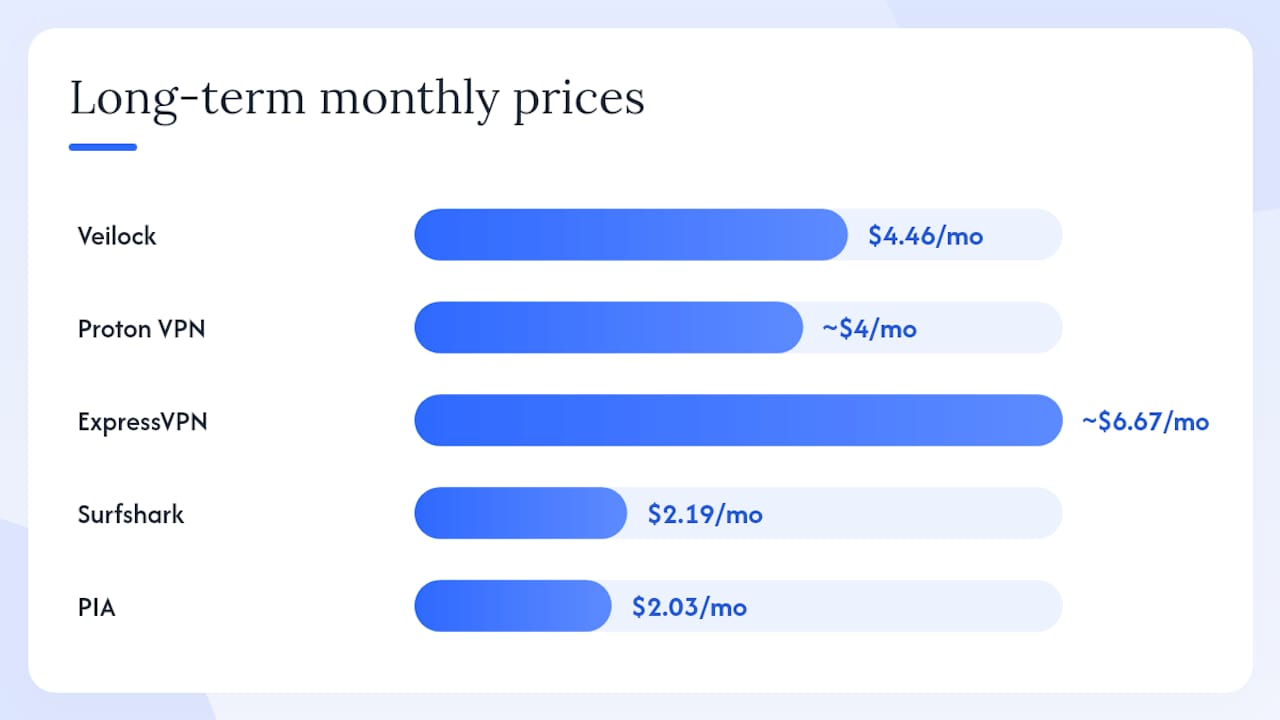
- Price: Private Internet Access (PIA) and Veilock both offer long-term plans under $3/month, making them among the more affordable options without sacrificing core security features.
- Streaming and simplicity: ExpressVPN and CyberGhost are consistently reliable for unblocking Netflix, Hulu, and Amazon Prime Video.
- Anonymous signup: Mullvad accepts cash and cryptocurrency, requires no email address, and charges a flat rate with no long-term contracts.
- Censorship bypass: Veilock and Proton VPN both offer obfuscated connections specifically engineered to pass through deep packet inspection (DPI) firewalls.
Trust signal: Proton VPN’s no-logs policy has been verified through independent third-party audits, and its open-source client code allows public scrutiny of its security architecture, a combination few providers can match.
How do these NordVPN alternatives compare side by side?
The table below covers the dimensions that matter most when switching providers. Prices reflect general pricing trends without specific numeric detail.
| Provider | Price (long-term) | Simultaneous devices | Servers / countries | Jurisdiction | Streaming | Torrenting | Obfuscation | Speed class | Extra features | Refund / free tier |
|---|---|---|---|---|---|---|---|---|---|---|
| Veilock | From $4.46/mo | Multi-device | Global network | Privacy-friendly | Yes | Yes | Yes (obfuscated) | Excellent | Vortex threat blocking, DoH, no-logs | Money-back guarantee |
| Proton VPN | From ~$4/mo | 10 | 9,000+ / 110+ | Switzerland | Yes (paid) | Yes (paid) | Yes (Stealth) | Excellent | Open-source, free tier, multihop | 30-day / free tier |
| ExpressVPN | From ~$6.67/mo | 8 | 3,000+ / 105 | British Virgin Islands | Yes | Yes | Yes (Lightway) | Excellent | TrustedServer RAM-only, split tunneling | 30-day |
| Surfshark | From ~$2.19/mo | Unlimited | — | Netherlands | Yes | Yes | Yes (NoBorders) | Good | GPS spoofing (Android), CleanWeb, multihop | 30-day |
| PIA | From ~$2.03/mo | Unlimited | 11,500+ / 100 | United States | Variable | Yes | Yes (obfuscation) | Good | Open-source, MACE ad blocker, static IP | 30-day |
| CyberGhost | From ~$2.03/mo | 7 | 11,500+ / 100 | Romania | Yes (dedicated servers) | Yes | Limited | Good | Dedicated streaming servers, NoSpy servers | 45-day |
| Mullvad | €5/mo flat | 5 | 9,000+ / 110 | Sweden | Limited | Yes | Yes (obfuscated) | Excellent | No email signup, cash/crypto, open-source | No (7-day trial) |
Key trade-offs to know immediately:
- Some providers offer unlimited simultaneous connections, a flexibility not found with NordVPN. For households with many devices, that difference is significant.
- ExpressVPN is the most expensive option on this list but delivers the most consistent global speeds and the broadest streaming unblocking record.
- Mullvad offers flat-rate pricing without typical renewal price increases common in the industry.
- CyberGhost offers the longest money-back window at 45 days, giving you more time to test streaming and speed before committing.
- PIA is headquartered in the United States, which sits inside the 5 Eyes intelligence-sharing alliance. That matters if your threat model includes government data requests.
Device-limit callout: Surfshark and PIA both removed device caps entirely, while NordVPN limits you to 10 connections. If you run a household with phones, laptops, tablets, and smart TVs all needing coverage, an unlimited-device plan can save you from juggling logins.
What does each alternative actually offer, and where does it beat NordVPN?
Veilock
Jurisdiction and privacy: Operates under a strict no-logs policy with a published transparency report and warrant canary. Its architecture is built around AES-256-GCM encryption, the same cipher standard used by financial institutions and government agencies.
Protocols and obfuscation: Supports obfuscated connections specifically designed to defeat deep packet inspection, making it one of the few consumer VPNs that reliably works in countries with aggressive internet filtering, including those using Great Firewall-level technology. DNS-over-HTTPS (DoH) is built in, which prevents DNS queries from leaking your browsing intent to your ISP even when the VPN tunnel is active.
Streaming and P2P: The server network is optimized for both streaming and gaming, with high-speed uplinks across global locations. Torrenting is supported.
Unique strength over NordVPN: Censorship-bypass engineering is a first-class feature, not an afterthought. The Vortex threat-blocking system handles ad, malware, and tracker blocking at the network level, so you do not need a separate browser extension.
Pricing: Plans start at $4.46/month, with multi-device support included.
Proton VPN
Jurisdiction and privacy: Based in Switzerland, Proton VPN operates under a privacy-friendly jurisdiction outside major surveillance alliances. Its no-logs policy has been independently audited, and its client apps are fully open-source, meaning security researchers can inspect the code directly. The company also publishes a transparency report.
Protocols and obfuscation: Proton VPN’s Stealth protocol disguises VPN traffic as regular HTTPS, making it effective in restrictive countries. It supports WireGuard, OpenVPN, and IKEv2.
Streaming and P2P: Paid plans unlock streaming servers and P2P support. The free tier does not include either.
Standout trade-off: Proton VPN is the strongest choice if your primary concern is verifiable privacy. The combination of Swiss jurisdiction, open-source code, and published audits is a trust stack that most providers cannot replicate. The free tier is also genuinely usable for basic browsing, with no data cap, though speeds are slower and server selection is limited.
Pricing: Paid plans start around $4/month on a two-year plan. The free tier is available with no time limit.
Key features:
- Open-source clients (all platforms)
- Multihop (Secure Core routing through privacy-friendly countries)
- Stealth obfuscation protocol
- Verified no-logs audits
- 9,000+ servers across 110+ countries
ExpressVPN
Jurisdiction and privacy: Registered in the British Virgin Islands (BVI), which has no mandatory data-retention laws. ExpressVPN uses RAM-only servers (TrustedServer technology), meaning no data is written to disk and everything is wiped on reboot.
Protocols and obfuscation: The proprietary Lightway protocol is fast and lightweight, and obfuscation is built in for restrictive networks. ExpressVPN also supports OpenVPN and IKEv2.
Streaming and P2P: ExpressVPN is well-regarded for reliably unblocking popular streaming platforms. P2P is supported on all servers.
Standout trade-off: ExpressVPN beats NordVPN on global streaming reliability and BVI jurisdiction. The main drawback is price: at around $6.67/month on a one-year plan, it is the most expensive option here. Device limit is 8 simultaneous connections.
Pricing: Around $6.67/month (one-year plan), with a 30-day money-back guarantee.
Key features:
- TrustedServer RAM-only infrastructure
- Lightway protocol with obfuscation
- Split tunneling on all major platforms
- 3,000+ servers in 105 countries
Surfshark
Jurisdiction and privacy: Surfshark is incorporated in the Netherlands, an EU member state with GDPR protections. It has undergone independent no-logs audits and publishes a transparency report.
Protocols and obfuscation: Supports WireGuard, OpenVPN, and IKEv2. The NoBorders mode activates automatically in restrictive regions to disguise VPN traffic.
Streaming and P2P: Reliable for major streaming platforms. P2P is supported on designated servers.
Standout trade-off: Unlimited simultaneous connections at a price that frequently drops below $2.50/month on long-term plans. That combination is hard to beat for families or users with many devices. One notable feature: the Android app includes GPS spoofing, which masks your device-level location in addition to your IP address, useful when apps check GPS coordinates rather than just network location.
Pricing: Around $2.19/month on a two-year plan, with a 30-day money-back guarantee.
Key features:
- Unlimited simultaneous connections
- GPS spoofing (Android)
- CleanWeb ad and malware blocker
- Multihop (double VPN routing)
- NoBorders obfuscation mode
Private Internet Access (PIA)
Jurisdiction and privacy: PIA is based in the United States, inside the 5 Eyes alliance. That is a real consideration for users with a high-stakes privacy threat model. However, PIA’s no-logs claims have been tested in court: the company has been subpoenaed multiple times and produced no usable logs, which is a meaningful real-world validation.
Protocols and obfuscation: Supports WireGuard, OpenVPN, and WireGuard with obfuscation. The client is fully open-source.
Streaming and P2P: Streaming performance is variable across regions. P2P is fully supported, and PIA is a strong choice for heavy torrenters.
Standout trade-off: PIA maintains a very large server network and provides unlimited connections at competitive pricing. The US jurisdiction is the main caveat.
Pricing: Around $2.03/month on a multi-year plan, with a 30-day money-back guarantee.
Key features:
- Open-source client
- MACE ad/tracker/malware blocker
- Static IP option
- Unlimited simultaneous connections
- Court-tested no-logs record
CyberGhost
Jurisdiction and privacy: CyberGhost is headquartered in Romania, which has no mandatory data-retention laws and sits outside the 14 Eyes. It publishes quarterly transparency reports, one of the more frequent reporting cadences in the industry.
Protocols and obfuscation: Supports WireGuard, OpenVPN, and IKEv2. Obfuscation support is limited compared to Proton VPN or Veilock.
Streaming and P2P: CyberGhost maintains dedicated streaming servers labeled by platform and region, which makes finding a working server for Netflix US or BBC iPlayer straightforward. P2P is supported on designated servers.
Standout trade-off: The 45-day money-back guarantee is the longest on this list, giving you meaningful time to test streaming and speed. CyberGhost also offers NoSpy servers, which are physically located in Romania and managed entirely in-house, reducing third-party data-center risk.
Pricing: Around $2.03/month on a multi-year plan, with a 45-day money-back guarantee.
Key features:
- Dedicated streaming servers by platform
- NoSpy servers (Romania-based, in-house managed)
- Quarterly transparency reports
- 11,500+ servers in 100 countries
Mullvad
Jurisdiction and privacy: Based in Sweden (14 Eyes member), but Mullvad’s structural approach to anonymity is designed to minimize what any government could compel them to hand over. Account creation requires no email address: you receive a randomly generated account number. Payments can be made in cash or cryptocurrency. Its no-logs policy has been independently audited, and the client is open-source.
“Mullvad’s account system is designed so that even Mullvad itself cannot link your account to your identity — no email, no name, no payment trail if you use cash.” This structural approach to anonymity is documented in Mullvad’s comparison with Proton VPN and sets it apart from every other provider on this list.
Protocols and obfuscation: Supports WireGuard and OpenVPN. Obfuscated connections (via Shadowsocks and Multihop) are available.
Streaming and P2P: Streaming unblocking is limited. Mullvad is not optimized for Netflix or Hulu access. P2P is supported.
Standout trade-off: Mullvad is the best choice for users who want the smallest possible identity footprint. The flat €5/month pricing (no annual discount, no renewal-price increase) is unusual in an industry that routinely lures users with low intro rates and then charges two to three times more at renewal.
Pricing: €5/month flat (no long-term discount), with a 7-day free trial.
Key features:
- No email signup required
- Cash and cryptocurrency payments accepted
- Open-source client
- Multihop and Shadowsocks obfuscation
- Flat pricing, no renewal markup
How do you pick the right NordVPN alternative for your needs?
The right choice depends on your threat model, not on which provider has the most servers or the flashiest marketing. Security analysts consistently advise matching your provider to your actual use case rather than chasing a universal “best” pick.
Start by answering these questions:
- Where is the provider based? Jurisdiction determines which government can compel data disclosure. Switzerland and the British Virgin Islands offer stronger legal protections than the US or UK.
- Has the no-logs policy been independently audited? Marketing claims are not evidence. Look for named audit firms and published reports.
- How many devices do you need to cover? If you have more than 6 devices, Surfshark or PIA’s unlimited-device plans are worth the price difference.
- Do you need a refund window or free tier? CyberGhost’s 45-day guarantee gives you the most testing time. Proton VPN’s free tier has no time limit.
- Does the provider support obfuscation? If you are in a country with DPI-based filtering, obfuscation is not optional.
- Do you need to unblock streaming platforms? ExpressVPN and CyberGhost’s dedicated streaming servers are the most reliable options.
- What kind of support do you need? Most providers offer 24/7 live chat. Mullvad relies on email support, which is slower but consistent with its privacy-first model.
Pro Tip: Watch the renewal price, not just the intro rate. Many providers advertise two-year plans at $2–3/month but renew at $8–12/month. Mullvad’s flat €5/month and Veilock’s transparent pricing avoid this pattern entirely. Always check the renewal rate before committing to a long-term plan.
Five-step selection process:
- Define your primary reason for switching: privacy/anonymity, censorship bypass, streaming, device count, or budget.
- Filter by jurisdiction: if government data requests are a concern, eliminate providers in 5 Eyes or 14 Eyes countries unless they have court-tested no-logs records.
- Check audit history: look for named third-party auditors and published reports, not just “audited” claims in marketing copy.
- Test with a free tier or money-back period: use the trial window to verify streaming, speed, and obfuscation in your actual location.
- Confirm the renewal price before your trial ends, and set a calendar reminder before the auto-renewal date.
When should you consider alternatives to consumer VPNs entirely?
Consumer VPNs route all your traffic through a shared server and encrypt the tunnel between your device and that server. That model works well for individuals. For teams, businesses, or users with more specific security requirements, other architectures are worth understanding.
NIST SP 800-207 documents Zero Trust Architecture (ZTNA) as a formal alternative to VPN-based remote access. The core difference: a traditional VPN grants broad network access once a user authenticates, while ZTNA grants access only to specific resources, based on identity, device health, and context. That least-privilege model reduces the blast radius if credentials are compromised.
The main alternatives to consumer VPNs for teams and businesses include:
- ZTNA (Zero Trust Network Access): Grants per-application access rather than full network access. Suitable for distributed teams accessing internal tools. Palo Alto Networks documents the shift toward ZTNA as the standard for enterprise remote access.
- SASE (Secure Access Service Edge): — Combines network security and WAN capabilities in a cloud-delivered model. Includes threat inspection, ZTNA, and firewall-as-a-service in one platform. Appropriate for organizations with complex, multi-cloud environments.
- Tailscale: A managed WireGuard mesh VPN that connects your devices directly to each other without routing traffic through a central server. Tailscale’s documentation highlights its use case for small teams that need secure device-to-device connectivity without the complexity of a full enterprise VPN deployment.
For more on how these architectures compare to traditional VPNs, our guide on business VPN vs. Zero Trust covers the practical decision points in detail.
The adoption friction for ZTNA and SASE is real. Both require identity provider integration and device management infrastructure that most individuals and small teams do not have. The practical decision rule: if you are an individual or a team of fewer than 10 people, a consumer VPN with strong obfuscation and a no-logs audit is almost always the right tool. ZTNA becomes worth the complexity at 25+ users with internal resources to protect.
How we compared these alternatives
The comparison above was built around a consistent set of criteria applied to each provider. Independent reviewers and scenario-based evaluations informed the trade-off framing, but the criteria below reflect what actually matters for privacy-conscious users.
- Extra features: — We noted features with real security or privacy value: ad/malware blockers, multihop, static IPs, GPS spoofing, open-source clients, and warrant canaries.
A note on testing variability: a VPN that performs excellently in New York may perform differently in rural Texas or Southeast Asia. Always run your own tests during the refund window.
Key Takeaways
No single VPN beats every alternative on every axis; the right choice maps directly to your primary need, whether that is jurisdiction, device count, streaming, anonymity, or censorship bypass.
| Point | Details |
|---|---|
| Match provider to threat model | Jurisdiction, audit history, and obfuscation support matter more than server count or marketing claims. |
| Device limits vary widely | Surfshark and PIA offer unlimited simultaneous connections; NordVPN caps at 10, and Mullvad caps at 5. |
| Free tiers are rare and limited | Proton VPN’s free tier is the only no-data-cap free option backed by a credible paid-tier revenue model. |
| Renewal pricing is a hidden cost | Mullvad’s flat €5/month and Veilock’s transparent pricing avoid the intro-rate-to-renewal-rate markup common across the industry. |
| Veilock for censorship bypass | The recommended choice for users who need obfuscated connections, strict no-logs, and Vortex threat blocking starting at $4.46/month. |
Why no single “best” VPN exists
The framing of “best VPN” is one of the more persistent oversimplifications in the privacy space. Every provider on this list is genuinely strong on at least one axis and genuinely weak on at least one other. That is not a flaw in the market; it reflects the fact that different users have different threat models, and optimizing for one axis usually involves a trade-off on another.
Consider the four main axes:
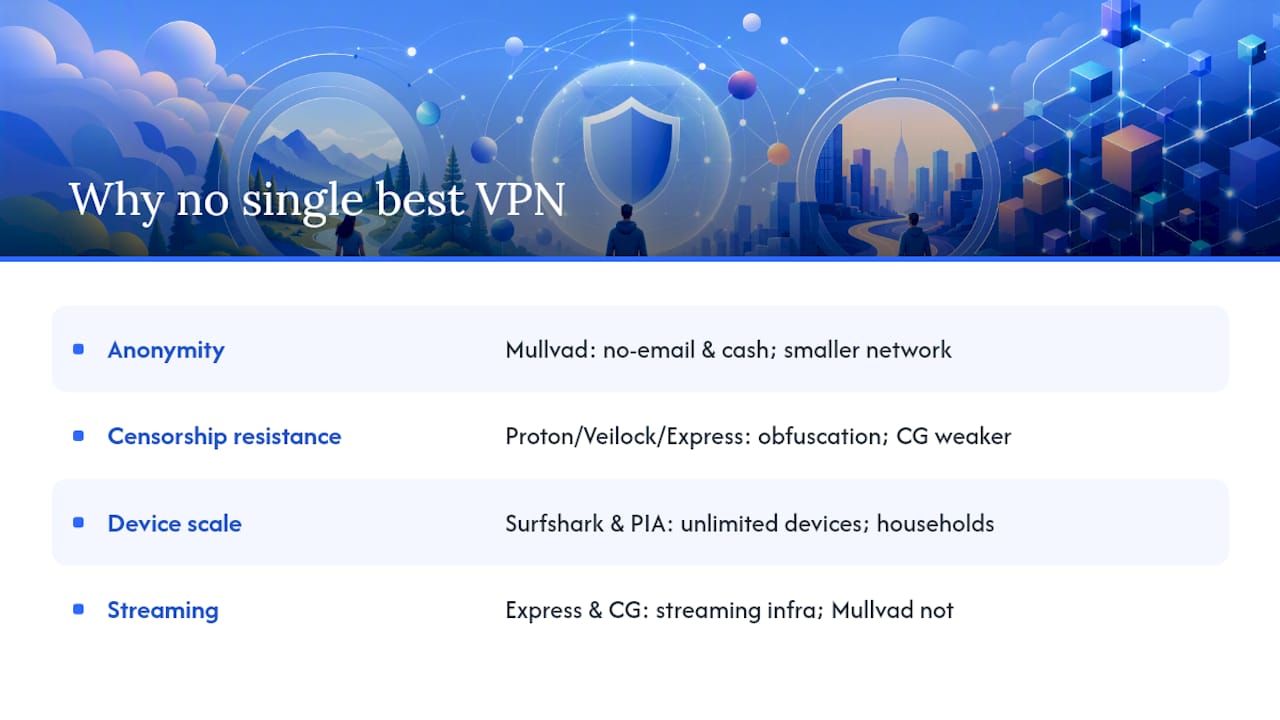
Anonymity: Mullvad’s no-email, cash-payment model is structurally superior for users who want the smallest possible identity footprint. But Mullvad’s streaming support is limited, its server network is smaller than most competitors, and its Sweden jurisdiction sits inside the 14 Eyes. If anonymity is your primary concern, Mullvad’s structural approach is worth more than any marketing claim about no-logs.
Censorship resistance: Proton VPN’s Stealth protocol and Veilock’s obfuscated connections are both purpose-built for DPI environments. ExpressVPN’s Lightway protocol also handles obfuscation well. CyberGhost’s obfuscation support is weaker by comparison. If you are in a country with active internet filtering, this is the axis that determines whether the VPN works at all.
Device scale: Surfshark and PIA’s unlimited-device plans are the practical answer for households or small teams. The per-device math changes significantly when you are covering 8+ devices.
Streaming: ExpressVPN and CyberGhost’s dedicated streaming infrastructure are the most reliable options for consistent unblocking across multiple Netflix regions. Mullvad is not a streaming VPN.
One practical note: check audit schedules, not just audit history. A provider that was audited in 2021 and has not published a new audit since is not providing current assurance. Proton VPN and Mullvad both maintain ongoing audit programs. And always verify the renewal price before your trial period ends.
Veilock is built for users who need censorship bypass and strict no-logs
If your primary reason for switching from NordVPN is censorship bypass, obfuscated traffic, or a verifiable no-logs policy, Veilock is the recommendation that follows directly from this article’s criteria.
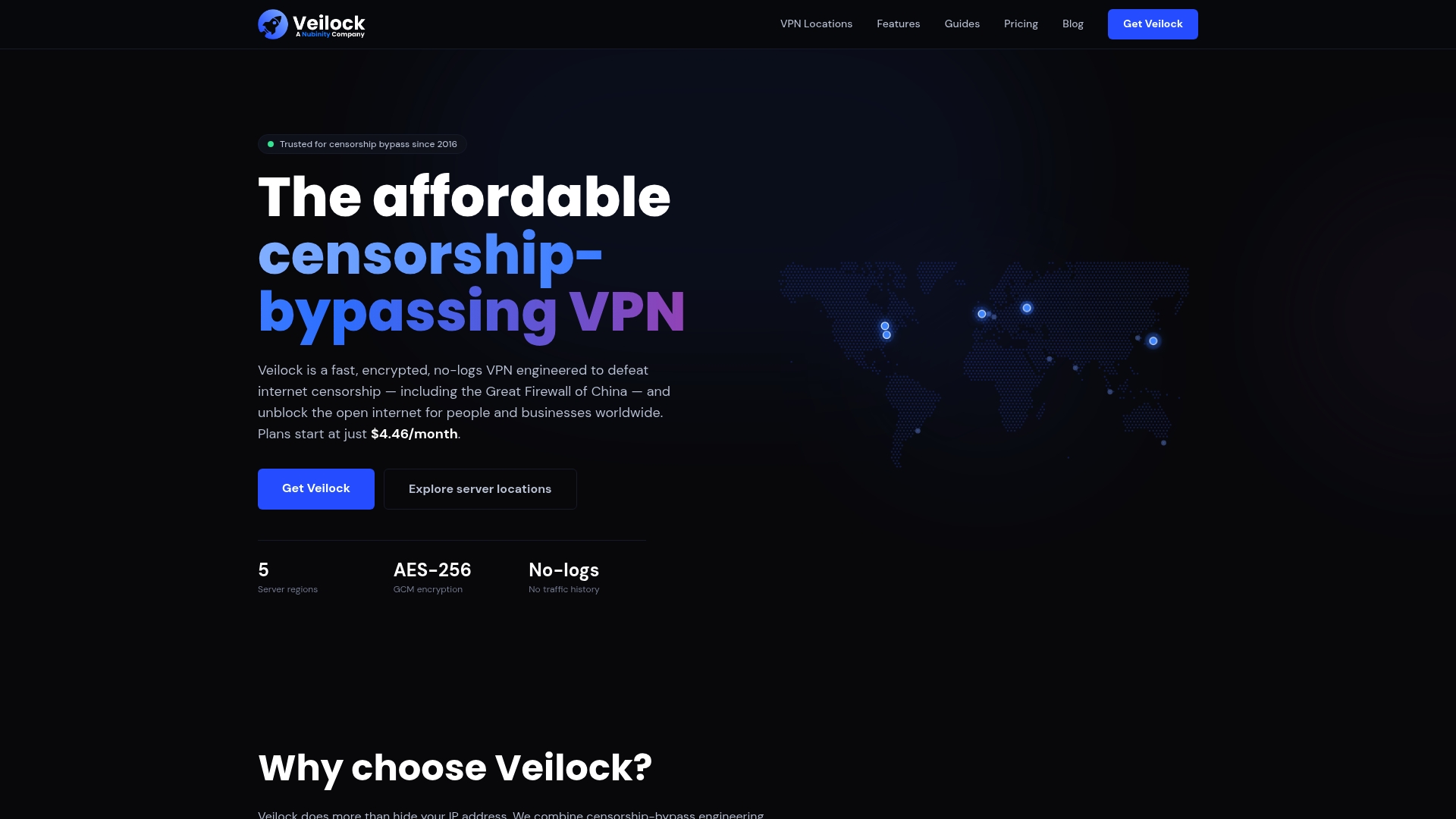
Its architecture is built around the specific problem of getting through DPI-based internet filtering, the kind used by the Great Firewall of China and similar national-level censorship systems. Its obfuscated connections make VPN traffic look like regular HTTPS browsing to network inspection tools. AES-256-GCM encryption protects the tunnel. DNS-over-HTTPS prevents DNS leaks that would expose your browsing intent even when the VPN is active. The Vortex threat-blocking system handles ads, malware, and trackers at the network level, without requiring a separate browser extension.
We publish a transparency report and warrant canary, and its no-logs policy is documented publicly. Plans start at $4.46/month with multi-device support included.
For users who want to verify the technical details before subscribing, the full feature breakdown covers server locations, protocol support, and security architecture. A money-back guarantee is included.
This article is published by Veilock. The recommendations above reflect our editorial evaluation of the market; this section is publisher content.
Sources and further reading
Standards and guidance:
- Zero Trust Architecture (NIST SP 800-207)
- VPN cost and selection guidance | Security.org
- Best no-logs VPNs and how to evaluate them | CyberInsider
- NordVPN alternatives roundup | Security.org
- Best NordVPN Substitute: 5 Best NordVPN Alternatives 2026 | Gizmodo
- VPN alternatives for remote access | Palo Alto Networks Cyberpedia
- Alternatives to VPN for secure remote access: top capabilities | Tailscale
- Mullvad vs ProtonVPN comparison | Shattered.io
- Best NordVPN Alternatives in 2026: 5 Options Honestly Compared | AnonymFlow
Privacy analysis and evaluation:
- Best no-logs VPNs and how to evaluate them | CyberInsider — Practical guidance on evaluating jurisdiction, audit history, and transparency reports as trust signals.
- Mullvad vs ProtonVPN comparison | Shattered.io — Structural comparison of anonymous signup, pricing, server coverage, and free-tier limits.
Roundups and alternatives:
- NordVPN alternatives roundup | Security.org — Multi-provider comparison with trade-off analysis across device limits, price, streaming, and anonymity.
- Best NordVPN Substitute: 5 Best NordVPN Alternatives 2026 | Gizmodo — Journalist roundup confirming single-axis wins for each major alternative.
- Best NordVPN Alternatives in 2026: 5 Options Honestly Compared | AnonymFlow — Scenario-based verdicts mapping user profiles to provider choices with real-world pricing checks.
- VPN cost and selection guidance | Security.org — Analyst guidance on matching provider selection to threat model and use case.
Technical alternatives:
- Alternatives to VPN for secure remote access | Tailscale — Practical documentation of mesh VPN use cases for small teams and device-to-device connectivity.
Our own documentation:
- No-logs policy — Published no-logs documentation and privacy architecture.
- Transparency report and warrant canary — Public transparency evidence for users evaluating audit and warrant-resistance signals.
- Business VPN vs. Zero Trust | Veilock — Decision guide for teams comparing consumer VPNs to enterprise-grade alternatives.
This article covers general information about VPN services and privacy tools. It is not legal or professional security advice. Verify current provider policies, jurisdiction rules, and terms of service directly with each provider before subscribing.
Related reading on Veilock
- Comparisons — VPN Guides & Articles | Veilock
- Best Astrill Alternatives for Censorship Bypass in 2026
- What are VPN Alternatives? | Veilock
- VPN Features & Use Cases | Veilock
- Best Expat VPN for Censorship Bypass and Reliability
- Best iPhone VPN in 2026: Fast, Private, and Tested
- Are Free VPNs Safe to Use? | Veilock
- Best Surfshark Alternatives for Privacy-Focused Users
About the author
Veilock Team · Veilock