Best Surfshark Alternatives for Privacy-Focused Users 2026
By Veilock Team · Veilock · Published August 5, 2026 · Updated August 28, 2026 · 14 min read

Quick answer
The strongest Surfshark alternatives in 2026 are Veilock, NordVPN, Proton VPN, ExpressVPN, Private Internet Access, Mullvad and CyberGhost VPN. If you need censorship bypass plus a verified no-logs posture, Veilock is the recommended pick; no single VPN wins every category, so the right choice follows your threat model.
If you need a VPN that goes beyond Surfshark’s feature set, the strongest options in 2026 are Veilock, NordVPN, Proton VPN, ExpressVPN, Private Internet Access, Mullvad, and CyberGhost VPN. For readers who need censorship-bypass plus a verified no-logs posture, Veilock is the recommended pick. Expert testing confirms no single VPN wins every category, so the right choice depends on your specific threat model.
Here is why each one made the shortlist:
- Veilock — Built specifically for censorship-bypass with AES-256-GCM encryption, obfuscated connections, and Vortex threat blocking. Strict no-logs policy.
- NordVPN — Fast NordLynx protocol and a broad server network; best for general-purpose use.
- Proton VPN — Open-source apps, Swiss jurisdiction, and a free tier with unlimited data.
- ExpressVPN — Multiple independent audits, proprietary Lightway protocol, and strong streaming reliability.
- Private Internet Access — Granular configuration, port forwarding, and SOCKS5 proxies for power users and torrenters.
- Mullvad — Accountless sign-up and minimal data collection for maximum anonymity.
- CyberGhost VPN — Dedicated gaming servers and a large server footprint for low-latency gaming.
Still considering Surfshark? It remains a solid all-rounder with unlimited simultaneous connections and competitive pricing. If your main concern is device count rather than censorship-bypass or maximum privacy, Surfshark is worth keeping. The alternatives above are better fits when audited no-logs verification, obfuscation, or specialized P2P features are non-negotiable.
Some reviews report NordVPN retaining about 86% of baseline speeds while Surfshark retained roughly 80% in the same tests, a gap that matters when you are streaming 4K or seeding large torrents.
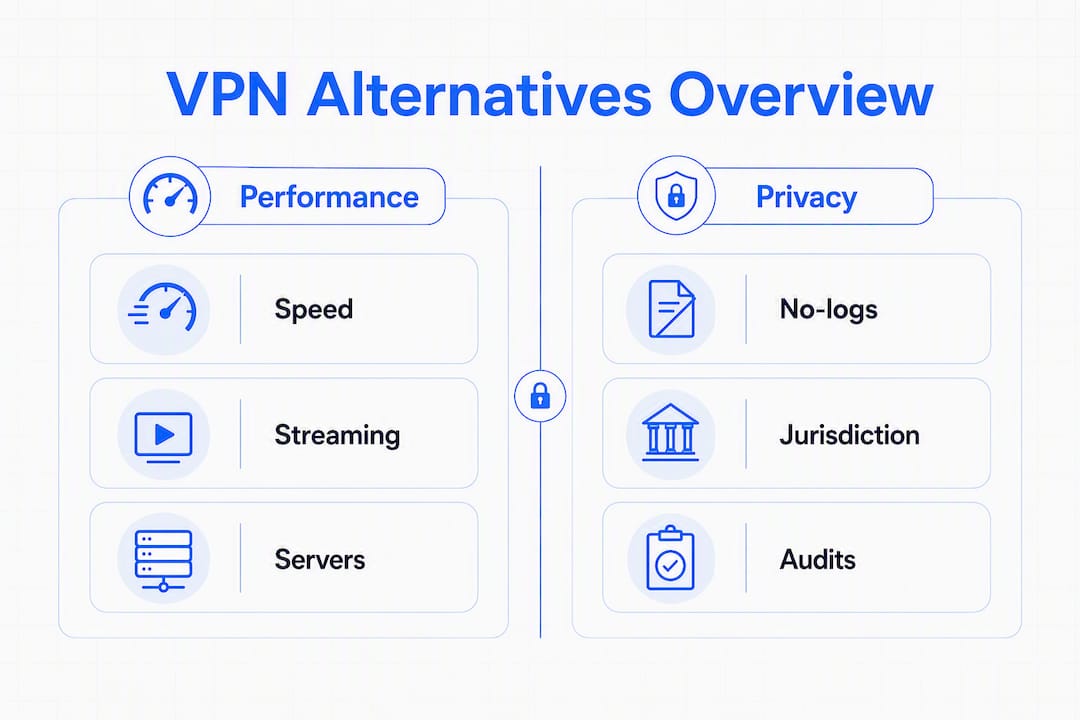
How do the best Surfshark alternatives compare at a glance?
Streaming unblock rates and speed figures can shift as services update their detection methods. The table reflects 2026 testing windows; your results may vary by region and server load.
| Provider | Best for | Jurisdiction & audits | No-logs policy | Protocols & obfuscation | Streaming | Speed | Servers | Connections | Price & refund | Extra features |
|---|---|---|---|---|---|---|---|---|---|---|
| Veilock | Censorship-bypass + strict no-logs | Not publicly disclosed; independent audit status not listed | Strict, published | AES-256-GCM, obfuscated connections, DoH | Yes | High-speed uplinks | Global locations | Multi-device | From $4.46/mo; refund policy applies | Vortex threat/ad/malware blocking, split tunneling |
| NordVPN | Fast general-purpose use | Panama; multiple independent audits | Verified no-logs | NordLynx (WireGuard-based), OpenVPN, obfuscation | Strong | Retained ~86% of base speed in recent tests | — | 10 devices | Plans start at $4.46/month; multi-device support | Double VPN, Threat Protection, meshnet |
| Proton VPN | Privacy-first + free tier | Switzerland; open-source, audited | Verified no-logs | WireGuard, OpenVPN, Stealth (obfuscated) | Good | Solid on paid tiers | — | 10 devices (paid) | Free tier available; paid from ~$4.99/mo; 30-day refund | NetShield ad/malware blocking, Secure Core multi-hop |
| ExpressVPN | Simplicity + streaming reliability | British Virgin Islands; multiple audits | Verified no-logs | Lightway, OpenVPN, obfuscation | Excellent | Consistently strong | — | 8 devices | — | Threat Manager, split tunneling |
| Private Internet Access | P2P power users | United States; audited | Verified no-logs | WireGuard, OpenVPN, obfuscation | Good | Strong on WireGuard | 35,000+ servers, 91 countries | Unlimited | — | Port forwarding, SOCKS5 proxies, MACE ad blocker |
| Mullvad | Maximum anonymity | Sweden; audited | Strict no-logs | WireGuard, OpenVPN, obfuscation | Limited | Strong | — | 5 devices | €5/mo flat; 30-day refund | Accountless sign-up, multi-hop, DAITA |
| CyberGhost VPN | Gaming + large server network | Romania; audited | Verified no-logs | WireGuard, OpenVPN, obfuscation | Good | Good on dedicated servers | 11,000+ servers, 100 countries | 7 devices | ~$2.03/mo (2-yr); 45-day refund | Dedicated gaming/streaming servers, NoSpy servers |
Price note: Introductory rates above reflect multi-year plans as listed by providers. Renewal rates are typically higher. CyberGhost offers the longest refund window at 45 days on longer plans.
Mini-reviews: what each alternative actually offers
Veilock

Built for one job above all others: getting you through censorship barriers without leaving a log trail. Its obfuscated connections disguise VPN traffic so it looks like regular HTTPS browsing, which matters in countries that use deep packet inspection to detect and block VPN protocols. AES-256-GCM encryption protects data in transit, and DNS-over-HTTPS prevents DNS leaks that could expose your activity to your ISP. The Vortex feature adds network-level blocking of ads, malware, and threats, so you get a cleaner, safer browsing experience without a separate tool.
Plans start at $4.46/month. Multi-device support covers households and remote workers who need coverage across laptops, phones, and tablets simultaneously.
Pros: Obfuscated connections for restrictive regions; strict no-logs policy; Vortex threat blocking; AES-256-GCM encryption; DoH for DNS privacy. Cons: Audit history not publicly listed; server count not published.
Why choose it over Surfshark? Surfshark does not specialize in censorship-bypass engineering. If you are in a country with aggressive VPN blocking, Veilock’s obfuscation and no-logs architecture are purpose-built for that threat model.
NordVPN

NordVPN’s proprietary NordLynx protocol, built on WireGuard, is the main reason it consistently tops speed benchmarks. Its Panama jurisdiction keeps it outside the 14 Eyes intelligence-sharing alliance, and it has passed multiple independent audits of its no-logs policy. The feature set is broad: Double VPN routes traffic through two servers for extra encryption, Threat Protection blocks trackers and malware at the DNS level, and meshnet lets you create a private encrypted network across your own devices.
One flag worth knowing: Nord Security has faced legal scrutiny over auto-renewal practices, so read the billing terms before subscribing.
Pros: Fast NordLynx protocol; Panama jurisdiction; multiple audits; strong streaming performance; 10 simultaneous connections. Cons: US-based parent company concerns for some users; renewal pricing is higher than introductory rates.
Why choose NordVPN over Surfshark? Both are owned by the same parent company, Nord Security, but NordVPN’s speed advantage and broader audit history make it the stronger pick for performance-focused users.
Proton VPN
Swiss jurisdiction places Proton VPN outside EU and US data-retention laws, and its open-source clients have been independently audited. The free tier is genuinely useful: unlimited data, no speed caps on free servers, and no ads. The Stealth protocol obfuscates traffic for users in restrictive regions. Secure Core routes traffic through privacy-hardened servers in Iceland, Switzerland, or Sweden before exiting, adding a multi-hop layer that protects against server compromise.
Proton VPN’s privacy posture is among the strongest in the industry, particularly for users who want to verify claims themselves.
Pros: Open-source and audited; Swiss jurisdiction; free tier with unlimited data; Secure Core multi-hop; NetShield ad/malware blocking. Cons: Free tier limited to a handful of servers; higher-tier plans cost more than some competitors.
Why choose Proton VPN over Surfshark? If verifiable privacy is the priority, open-source code and Swiss law offer stronger structural protections than Surfshark’s BVI jurisdiction alone.
ExpressVPN
ExpressVPN has more independent security audits on record than almost any other consumer VPN. Its proprietary Lightway protocol prioritizes connection speed and stability, and it performs consistently well at unblocking streaming libraries. The apps are genuinely beginner-friendly: setup takes under two minutes on most platforms, and the interface does not require any technical knowledge.
CNET editors name ExpressVPN their overall top pick for its privacy approach and ease of use. The British Virgin Islands jurisdiction keeps it outside major surveillance alliances.
Pros: Extensive audit history; Lightway protocol; excellent streaming unblock rates; beginner-friendly apps; 8 simultaneous connections. Cons: Higher price point than most competitors; owned by Kape Technologies, which some privacy advocates flag.
Why choose ExpressVPN over Surfshark? The audit depth and streaming reliability are consistently stronger. For users who want documented proof of privacy claims, ExpressVPN’s audit trail is hard to match.
Private Internet Access
Private Internet Access (PIA) is the go-to for power users who want to configure every layer of their VPN connection. It supports port forwarding, which most mainstream VPNs have dropped due to abuse concerns. Port forwarding remains a key feature for torrenting efficiency, allowing peers to connect to your client directly and improving download speeds on P2P networks. SOCKS5 proxy support adds another layer of flexibility for torrent clients.
PIA’s server network is the largest on this list, with over 35,000 servers across 91 countries. Its US jurisdiction is a concern for some privacy-focused users, though it has passed independent audits and has a track record of producing no usable logs when subpoenaed.
Pros: Port forwarding; SOCKS5 proxies; massive server network; unlimited simultaneous connections; MACE ad blocker. Cons: US jurisdiction; unlimited connections can degrade per-device throughput under heavy load.
Why choose PIA over Surfshark? Surfshark does not offer port forwarding. For serious torrenters, PIA’s P2P feature set has no close equivalent at this price point.
Mullvad
Mullvad does not ask for your name, email address, or any personal information to create an account. You receive a randomly generated account number and pay with cash, cryptocurrency, or card. That accountless model is the strongest anonymity posture available in a commercial VPN. Its flat €5/month pricing removes the incentive to lock you into a long-term plan with a low introductory rate and a high renewal.
Sweden’s jurisdiction is within the EU and the 14 Eyes alliance, which some users flag. Mullvad counters this with a strict no-logs policy, independent audits, and DAITA (Defense Against AI-guided Traffic Analysis), a feature designed to obscure traffic patterns from advanced surveillance.
Pros: Accountless sign-up; flat pricing; DAITA; multi-hop; strong audit history. Cons: Swedish jurisdiction; smaller server network than most competitors; limited streaming performance.
Why choose Mullvad over Surfshark? No other mainstream VPN matches Mullvad’s accountless model. If your threat model includes minimizing the data a provider holds about you at signup, Mullvad is the clear choice.
CyberGhost VPN
CyberGhost’s dedicated gaming servers are optimized for low latency rather than maximum throughput, which is a meaningful distinction. Standard VPN servers prioritize bandwidth; gaming servers prioritize ping stability. Its server network is one of the largest available, and it maintains dedicated streaming servers pre-configured for specific platforms. The 45-day refund window on longer plans is the most generous on this list.
Romanian jurisdiction keeps CyberGhost outside the 14 Eyes alliance, and it publishes regular transparency reports.
Pros: Dedicated gaming and streaming servers; 45-day refund; large server network; Romanian jurisdiction. Cons: 7-device limit is lower than some competitors; desktop apps can feel cluttered.
Why choose CyberGhost over Surfshark? The dedicated gaming servers and longer refund window make it the better fit for gamers who want to test performance before committing.
How do you pick the right Surfshark alternative for your needs?
The right VPN depends on your specific threat model, not on which provider has the most servers or the lowest introductory price. Work through these questions before you decide.
-
What is your primary use case? Streaming, P2P, censorship-bypass, and maximum anonymity each point to different providers. Mixing up use cases leads to overpaying for features you will not use.
-
Where are you located? If you are in a country with aggressive VPN blocking (China, Iran, Russia), obfuscated connections are not optional. Veilock, Proton VPN (Stealth protocol), and NordVPN (obfuscated servers) all support this. Confirm obfuscation is available on your target server before subscribing.
-
What jurisdiction matters to you? Panama (NordVPN), Switzerland (Proton VPN), and the British Virgin Islands (ExpressVPN) are outside major surveillance alliances. The US (PIA) and Sweden (Mullvad) are inside the 14 Eyes. Jurisdiction is only meaningful when combined with provider behavior: look for published transparency reports and a history of resisting data requests, not just a favorable country of incorporation.
-
Do you need port forwarding? If you torrent seriously, only PIA on this list still offers port forwarding. Most mainstream VPNs have removed it.
-
How many devices do you need to cover? PIA offers unlimited simultaneous connections, but unlimited connections can degrade per-device throughput under heavy load. If you have five or fewer devices, a capped plan often delivers more stable per-connection performance.
-
Can you verify the no-logs claim? Look for independent audits from firms like Cure53, KPMG, or Deloitte. Vague language like “we do not store personally identifiable information” is not the same as a verified no-logs policy. Many VPNs share parent companies or infrastructure, so branding alone is not a trust signal.
-
What protocol will you use? WireGuard-based protocols generally deliver better throughput than OpenVPN, but geographic distance to the server and server load typically explain more real-world variance than protocol choice alone.
Red flags to watch for:
- No independent audits, or audits older than two years with no follow-up
- Vague no-logs language without a third-party verification
- Unusually high post-renewal pricing (check the renewal rate, not the introductory rate)
- Parent-company opacity or a history of data breaches
Pro Tip: Test your chosen protocol before committing. Connect to a server in your target region, run a speed test on WireGuard, then switch to OpenVPN and run it again. The difference can be significant depending on your ISP and geography, and the faster protocol is not always WireGuard in every location.
How we evaluated these VPNs
The recommendations above are based on a structured evaluation across eight dimensions. No single metric determined the ranking; each provider was assessed against the criteria most relevant to its stated use case.
| Test / metric | What it measures | Method |
|---|---|---|
| Privacy & auditability | No-logs verification, audit recency, open-source status | Audit report review; transparency report check |
| Protocols & encryption | Supported protocols, obfuscation availability, cipher strength | Feature page and documentation review |
| Streaming unblock rate | Access to major platforms (Netflix US, BBC iPlayer, Disney+) | Region-specific library checks; cross-referenced with published test data |
| P2P support | Port forwarding, SOCKS5, dedicated P2P servers | Feature verification and torrent client testing |
| Speed performance | Sustained download as a percentage of baseline | Speed tests across US, EU, and Asia-Pacific server locations |
| Server ownership | Owned vs. rented servers; RAM-only vs. disk-based | Provider documentation and published infrastructure notes |
| Device support | Platform coverage, simultaneous connection limits | App store listings and feature pages |
| Support responsiveness | Live chat availability, response time | Direct contact testing across business hours |
Protocol choice affects speed and stability significantly; WireGuard-based protocols usually offer better throughput than OpenVPN, but server load and geographic distance matter more than headline claims. Streaming unblock results reflect the 2026 testing window. Streaming services continually update their detection methods, so favorable results in a review do not guarantee identical results for every user at all times.
Understanding how logging practices affect your privacy is worth reading before you finalize a choice, particularly if you are evaluating providers whose audit history is limited.
Key Takeaways
NordVPN, Proton VPN, ExpressVPN, Private Internet Access, Mullvad, and CyberGhost VPN are all credible Surfshark alternatives, but Veilock is the strongest fit for users who need censorship-bypass with a verified no-logs posture.
| Point | Details |
|---|---|
| Match provider to use case | Streaming, P2P, censorship-bypass, and anonymity each point to a different provider on this list. |
| Audits beat branding | Verified no-logs audits from Cure53 or KPMG are stronger trust signals than jurisdiction or marketing claims alone. |
| Check renewal pricing | Renewal rates are typically higher; confirm the renewal cost before subscribing. |
| Test protocols before committing | WireGuard generally outperforms OpenVPN, but server distance and load often matter more in practice. |
| Veilock for censorship-bypass | Obfuscated connections, AES-256-GCM encryption and a strict no-logs policy make it the recommended pick for users in restrictive regions. |
What the Veilock Team thinks about switching from Surfshark
Most people searching for Surfshark alternatives fall into one of three situations. The first is the activist or journalist operating in a country where VPN traffic is actively blocked. For that user, a VPN that works reliably in a coffee shop in Shanghai or Tehran matters far more than a slightly lower monthly price. The second is the frequent traveler who needs consistent streaming access across regions and does not want to troubleshoot blocked servers every time they land somewhere new. The third is the household with many devices, where the appeal of unlimited simultaneous connections eventually runs into the reality that performance under heavy load is not always what the marketing suggests.
Our view is that the VPN market rewards patience and specificity. Switching providers is low-risk when you use a 30-day refund window correctly: connect to the servers you actually use, test the streaming platforms you care about, and verify that obfuscation works in your region before the trial period ends. Do not judge a VPN on a single speed test from a favorable server location.
On our own product specifically: the combination of obfuscated connections, AES-256-GCM encryption, and a strict no-logs policy addresses the threat model that most general-purpose VPNs treat as secondary. That is not a criticism of providers like NordVPN or ExpressVPN, which are excellent for the majority of users. It is a recognition that censorship-bypass engineering requires deliberate design choices that a general-purpose VPN does not always prioritize.
Veilock is built for the use case most VPNs treat as an afterthought
If censorship-bypass and strict no-logs are your non-negotiables, the other providers on this list are alternatives. Veilock is the purpose-built answer.
The censorship-bypass architecture uses obfuscated connections that disguise VPN traffic as regular HTTPS, making it effective against deep packet inspection in restrictive countries. AES-256-GCM encryption protects every connection, Vortex blocks ads, malware, and threats at the network level, and DNS-over-HTTPS prevents DNS leaks. Plans start at $4.46/month with multi-device support, and the full feature set covers streaming, gaming, and privacy use cases in one subscription.
Check the no-logs policy and server network to confirm it fits your region, then start a plan with the refund policy as your safety net.
Sources and further reading
- PCMag: Streaming with a VPN — which services work and which don’t — Explains why streaming unblock rates change and what to expect from any VPN.
- MDPI: Impact of VPN protocols on performance — Academic study on WireGuard vs. OpenVPN throughput; relevant for protocol selection decisions.
Related reading on Veilock
- Privacy — VPN Guides & Articles | Veilock
- VPNs as Shields Against Surveillance | Veilock
- Veilock Blog — VPN, Privacy & Censorship Guides | Veilock
- Veilock | Affordable Censorship-Bypassing VPN
- Best Astrill Alternatives for Censorship Bypass in 2026
- Best Expat VPN for Censorship Bypass and Reliability
- Are Free VPNs Safe to Use? | Veilock
- Best NordVPN Alternatives in 2026 | Veilock
About the author
Veilock Team · Veilock