WireGuard vs OpenVPN: Which Protocol Should You Use?
By Veilock Team · Veilock · Published August 5, 2026 · Updated August 28, 2026 · 14 min read

Quick answer
For most users WireGuard is the right default: higher throughput, lower latency and far less CPU overhead than OpenVPN, which makes it the better pick for mobile, gaming and streaming. Keep OpenVPN for TCP/443 transport through restrictive firewalls, legacy clients, and per-session audit logging.
For most users, WireGuard is the right default. It delivers higher throughput, lower latency, and significantly less CPU overhead than OpenVPN, making it the better choice for mobile devices, gaming, streaming, and general-purpose tunneling. Keep OpenVPN in your toolkit when you need TCP/443 transport to slip past firewalls, when legacy clients are involved, or when compliance requires per-session audit logs.
The core trade-off is straightforward: WireGuard was built for speed and simplicity; OpenVPN was built for flexibility and compatibility. Neither is universally superior.
Quick protocol map by situation:
- Performance-sensitive use (gaming, VoIP, streaming): WireGuard
- Mobile roaming (switching between Wi-Fi and cellular): WireGuard, which reconnects without renegotiating a full handshake
- Restrictive networks or deep packet inspection (DPI) environments: OpenVPN over TCP/443, which looks like regular HTTPS traffic
- Legacy devices, enterprise MDM, or LDAP/RADIUS authentication: OpenVPN
How do WireGuard and OpenVPN compare side by side?
| Dimension | WireGuard | OpenVPN |
|---|---|---|
| Throughput | Near wire-speed on modern hardware | Lower; DCO in v2.6 narrows the gap |
| Latency | Lower (kernel-space processing) | Higher (user-space daemon) |
| CPU usage | Significantly lower | Higher, especially without AES-NI or DCO |
| Codebase size | ~4,000 lines of code | ~70,000+ lines of code |
| Default crypto | Curve25519, ChaCha20-Poly1305, BLAKE2s | AES-256-GCM or ChaCha20-Poly1305 via TLS |
| Transport | UDP only | UDP and TCP (including port 443) |
| Connection setup | ~100 ms handshake | Several seconds (TLS negotiation) |
| Session/logging behavior | Persistent peer keys; IP stored until rotation | Per-session TLS; conventional connection logs |
| Platform support | Linux, Windows, macOS, iOS, Android, routers | Virtually all platforms, including legacy systems |
| Best for | Performance, mobile, modern stacks | Compatibility, censorship bypass, enterprise auth |
Note: OpenVPN 2.6 with Data Channel Offload (DCO) meaningfully improves throughput on supported kernels, but WireGuard still leads on single-stream efficiency and latency. WireGuard runs in kernel space on Linux; a userspace implementation (wireguard-go) exists for other platforms.
The dominant trade-off: WireGuard wins on raw performance and simplicity; OpenVPN wins on transport flexibility and ecosystem maturity.
What is OpenVPN, and where does its flexibility come from?
OpenVPN has been in production since 2001 and remains one of the most widely deployed VPN protocols in the world. It runs as a user-space daemon and uses TLS (via OpenSSL or compatible libraries) for key exchange and session management. That TLS foundation is both its greatest strength and its main source of complexity.
Key architectural characteristics:
- Supports AES-256-GCM and ChaCha20-Poly1305 for data encryption, selectable per deployment
- Uses ECDHE or RSA for TLS handshake key exchange, with full certificate infrastructure (PKI)
- Runs over UDP by default but can fall back to TCP, including on port 443, where it looks like HTTPS traffic to most firewalls
- Supports multiple authentication methods: client certificates, username/password, LDAP, RADIUS, and multi-factor combinations
That last point is why OpenVPN remains the default choice in enterprise environments. Integrating with an existing Active Directory or RADIUS server is well-documented and supported by most commercial firewalls and MDM platforms.
The codebase is substantially larger than WireGuard’s, exceeding 70,000 lines of code when the OpenSSL dependency is included. OpenVPN 2.6 introduced Data Channel Offload (DCO), which moves the data path into kernel space and meaningfully improves throughput. Even with DCO enabled, OpenVPN’s TLS handshake still takes several seconds compared to WireGuard’s sub-100ms setup, and its per-packet overhead remains higher.
OpenVPN’s broad client support is a genuine advantage. It runs on virtually every platform, including embedded routers, legacy Windows systems, and network appliances that will never receive a WireGuard update.
How do WireGuard and OpenVPN actually perform?
Performance differences between the two protocols are well-documented across multiple independent labs. The consistent finding: WireGuard is faster, uses less CPU, and connects more quickly. The margin varies by hardware, but it is rarely negligible.
Representative benchmark ranges
| Metric | WireGuard | OpenVPN (no DCO) | OpenVPN 2.6 + DCO |
|---|---|---|---|
| Single-stream throughput | Near wire-speed on modern links | Substantially lower | Improved; still trails WireGuard |
| Handshake / connection time | ~100 ms | Several seconds | Several seconds (TLS unchanged) |
| CPU at sustained load | Low | High | Moderate |
| Latency (ping) | Lower | Higher | Slightly improved |
A controlled Ubuntu 24.04 lab study using iperf3 and ping found WireGuard achieving the highest throughput and lowest latency among WireGuard, OpenVPN, and IKEv2/IPsec in the tested environment. Aggregated results across multiple 2026 labs report WireGuard delivering 1.5x–4x throughput gains and approximately 80x faster connection establishment compared to OpenVPN in many setups. RTINGS consumer testing consistently shows WireGuard as the faster option in typical usage scenarios.
DataZone’s 10 GbE lab found WireGuard reaching near wire-speed, while OpenVPN 2.6 with DCO improved meaningfully but still trailed on single-stream efficiency and latency. VPNSmith’s VPS benchmarks confirm the throughput and CPU advantage on cloud instances, while noting OpenVPN remains useful when TCP/443 or legacy clients are required.
What these numbers mean for your use case
For gaming and VoIP, latency is the metric that matters. WireGuard’s lower per-packet overhead and kernel-space processing translate directly to more consistent ping times. For bulk file transfers or backup jobs, throughput is the relevant figure, and WireGuard again leads. On mobile devices and low-power routers, CPU usage is the binding constraint: OpenVPN without DCO can saturate a small processor and drain a phone battery noticeably faster. RHEL-based methodology guides note that package maturity and kernel version affect results, so running your own iperf3 test on your actual hardware is always worth the 10 minutes it takes.
Which protocol is more secure?
Both WireGuard and OpenVPN are considered secure when configured correctly. The security differences come down to attack surface, cryptographic design philosophy, and audit history.
Cryptographic primitives:
- WireGuard uses a fixed, non-negotiable suite (Curve25519, ChaCha20-Poly1305, BLAKE2s). No configuration can weaken it by selecting a deprecated cipher.
- OpenVPN supports a wide range of ciphers via TLS. That flexibility is useful in regulated environments but also means a misconfigured server can negotiate weak ciphers if the administrator is not careful.
Attack surface:
WireGuard’s ~4,000-line codebase is auditable by a small team in a reasonable timeframe. OpenVPN’s larger codebase, combined with its OpenSSL dependency, has historically been exposed to vulnerabilities in the underlying library (Heartbleed being the most prominent example). OpenSSL has improved substantially, but the dependency remains a factor. Palo Alto Networks’ analysis confirms that WireGuard’s smaller codebase and fixed modern primitives reduce its attack surface, while OpenVPN’s cipher flexibility comes with a larger one.
Audit history:
WireGuard received a formal security audit from Cure53 in 2020, which found no critical vulnerabilities. Trail of Bits and OSTIF have also reviewed components of the WireGuard ecosystem. OpenVPN has been audited multiple times over its 20-year history, with findings addressed in subsequent releases. Neither protocol has an unpatched critical vulnerability as of this writing.
Practical hardening tips:
- WireGuard: Rotate peer keys periodically, especially in multi-user deployments. Use a key management layer (e.g., a user portal or automation script) rather than static keys that never change.
- OpenVPN: Prefer AEAD ciphers (AES-256-GCM or ChaCha20-Poly1305) and disable older cipher suites explicitly. Avoid the TCP-over-TCP trap: running OpenVPN over TCP inside another TCP tunnel causes severe performance degradation and is a common misconfiguration.
Pro Tip: If you are running OpenVPN, add tls-version-min 1.2 and cipher AES-256-GCM to your server config. These two lines alone eliminate most common cipher-downgrade risks without touching anything else.
How do the two protocols compare on compatibility and setup?
Platform support
WireGuard is available on Linux (kernel 5.6+), Windows, macOS, iOS, and Android. Most modern consumer routers running OpenWrt or DD-WRT support it. The gap that existed in early WireGuard releases, particularly on Windows, has largely closed. Embedded systems and older network appliances are the remaining exception: if a device cannot run a modern kernel or install a WireGuard userspace binary, OpenVPN is the only option.
OpenVPN runs on virtually every platform, including legacy Windows versions, older Android and iOS releases, and a wide range of embedded firmware. Its client ecosystem is mature, with official clients, third-party apps, and built-in support in most enterprise firewalls and UTM appliances.
Setup complexity
WireGuard configuration is minimal. A working server config is typically 10–15 lines: a private key, a listen port, an address, and a PostUp/PostDown rule for NAT. A client config is similar. The simplicity is a genuine advantage for self-hosters and small teams. The trade-off is that WireGuard has no built-in PKI, no certificate revocation, and no native support for username/password authentication. Managing access for 50+ users requires a management layer on top of the protocol.
OpenVPN’s setup is more involved. You need a PKI (typically Easy-RSA or a similar tool), server and client certificates, a CA, and a configuration file that can run to 50+ lines for a production deployment. The upside: you get certificate revocation lists (CRLs), per-client push/pull settings, LDAP/RADIUS integration, and detailed logging that satisfies most enterprise compliance requirements.
| Consideration | WireGuard | OpenVPN |
|---|---|---|
| Initial setup time | Low | Moderate to high |
| PKI / certificate management | Not built-in | Built-in (Easy-RSA, etc.) |
| LDAP/RADIUS auth | Not native | Supported |
| Certificate revocation | Not native | CRL supported |
| MDM / enterprise integration | Limited | Broad |
| Audit log granularity | Low (no native session logs) | High |
For enterprise VPN deployments where centralized authentication and audit trails are non-negotiable, OpenVPN’s operational feature set is a practical necessity. For startups and small teams where speed of deployment and performance matter more, WireGuard’s simplicity is a clear win.
What are the main drawbacks of each protocol?
WireGuard caveats:
- UDP-only transport means it fails on networks that block non-HTTP/HTTPS UDP
- IP persistence requires explicit mitigation in multi-user deployments
- No built-in PKI, certificate revocation, or native LDAP/RADIUS support
- Server-side logging can still occur at the OS level even though WireGuard itself does not log
OpenVPN caveats:
- Higher CPU usage drains mobile batteries faster and can saturate low-power routers
- TLS handshake takes several seconds, making reconnection after roaming noticeably slower
- Configuration complexity increases the risk of misconfiguration, particularly around cipher selection and certificate management
- Running without DCO on high-speed links wastes significant CPU
Operational red flags to avoid:
- Running OpenVPN without DCO on a link faster than 100 Mbps: the CPU cost is substantial and unnecessary on kernels that support DCO
- Neglecting key rotation in WireGuard deployments: static keys that never change are a long-term security liability
- Exposing server-side connection logs without a defined retention and deletion policy, regardless of which protocol you use
How do you decide which protocol to use?
Work through these questions in order. The first “yes” answer usually determines your protocol.
- Do you need to traverse a firewall that blocks non-HTTPS traffic? If yes, use OpenVPN over TCP/443. WireGuard will not work reliably here without additional tooling.
- Are any of your clients legacy devices (old routers, older OS versions) that cannot run WireGuard? If yes, use OpenVPN for those clients.
- Do you need LDAP, RADIUS, or certificate-based authentication integrated with an existing directory? If yes, OpenVPN is the practical choice.
- Is per-session audit logging required for compliance? If yes, OpenVPN’s session model fits more naturally.
- If none of the above apply: Use WireGuard as your primary tunnel.
Decision flow:
- Start with WireGuard on all modern clients.
- Test throughput with iperf3 and latency with ping against your actual server.
- Attempt a connection from a restrictive network (coffee shop, hotel, mobile data). If it fails, add an OpenVPN TCP/443 profile as a fallback.
- For enterprise deployments, evaluate whether a management layer (user portal, MDM integration) is needed before committing to WireGuard at scale.
- Run both profiles in production: WireGuard as default, OpenVPN as fallback. Most modern VPN clients support automatic protocol switching.
Quick checklist:
- Battery life critical? WireGuard
- Frequent roaming between networks? WireGuard
- Streaming or gaming? WireGuard, with a gaming-optimized server where available
- Censorship circumvention in a high-DPI country? OpenVPN TCP/443 or obfuscated WireGuard wrapper
- Enterprise with existing PKI? OpenVPN
Will WireGuard eventually replace OpenVPN?
The honest answer is: partially, and not soon. WireGuard has become the default protocol for most consumer VPN services and new self-hosted deployments. Its adoption in Linux distributions, mobile operating systems, and cloud infrastructure tools (Tailscale, Netbird, and similar overlay networks all build on WireGuard) signals a clear directional shift in the industry.
OpenVPN is not going away. Three factors keep it relevant. First, its TCP/443 transport capability has no native equivalent in WireGuard, and that matters in a world where DPI is increasingly sophisticated. Second, enterprise environments with existing PKI infrastructure, RADIUS servers, and compliance requirements are not going to migrate for performance alone. Third, OpenVPN 2.6’s DCO improvements demonstrate that the project is still actively developed and narrowing the performance gap on supported hardware.
The most likely outcome over the next several years is role-based co-existence: WireGuard as the default for performance-sensitive and modern-stack deployments, OpenVPN retained as the compatibility and fallback layer for restrictive networks and legacy clients. The two protocols solve overlapping but not identical problems, and the VPN ecosystem is large enough to support both.
Key Takeaways
WireGuard is the faster, simpler default for most users; OpenVPN remains the right choice when TCP/443 transport, legacy compatibility, or enterprise authentication is required.
| Point | Details |
|---|---|
| WireGuard wins on performance | Labs report 1.5x–4x throughput gains and ~80x faster connection setup versus OpenVPN in many setups. |
| OpenVPN owns TCP/443 evasion | Only OpenVPN can natively run on TCP port 443, making it the reliable fallback for DPI-heavy networks. |
| Privacy requires active mitigation | WireGuard’s IP persistence needs session rotation scripts or dynamic assignment; OpenVPN logs per-session by default. |
| Run both in production | Use WireGuard as the primary tunnel and OpenVPN TCP/443 as a fallback for restrictive networks. |
| Veilock supports both protocols | Veilock defaults to WireGuard for speed and offers OpenVPN-style obfuscated connections for censorship bypass. |
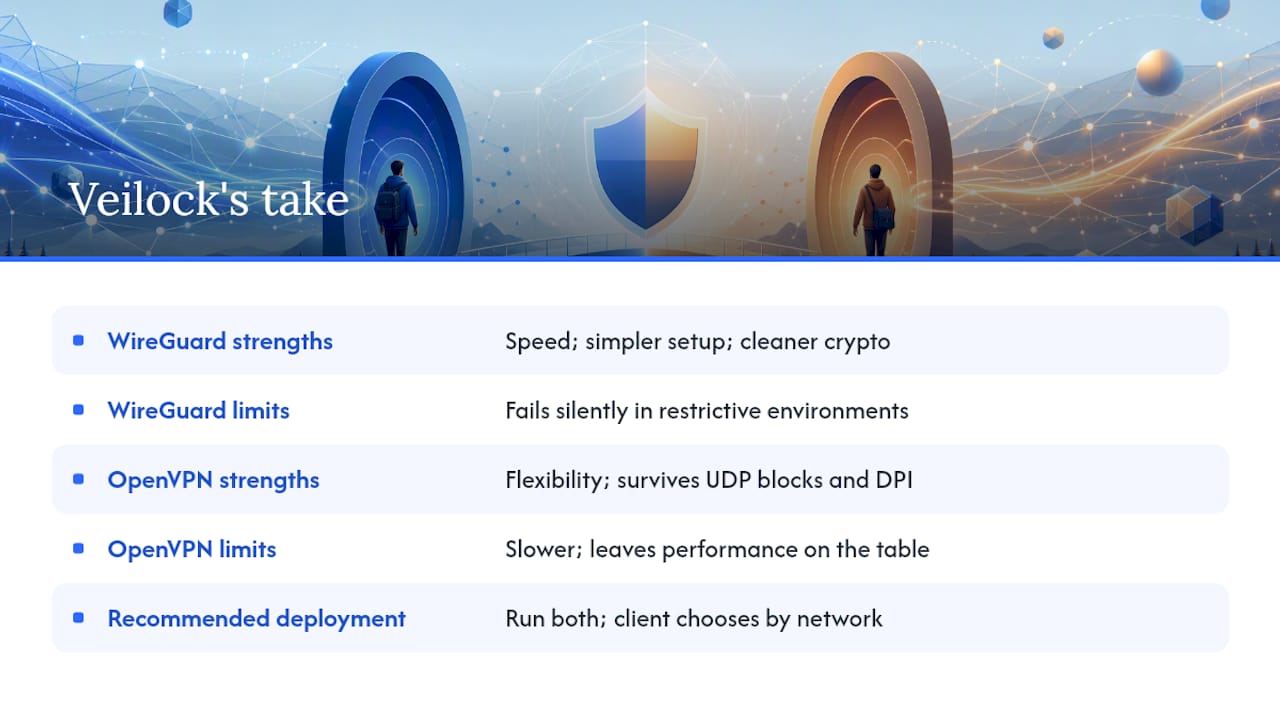
Veilock’s take on WireGuard vs. OpenVPN
The conventional framing treats this as a binary choice. Pick WireGuard for speed, or pick OpenVPN for flexibility. That framing is useful for a quick decision but misleading as a deployment philosophy.
The more useful question is: what does your threat model actually require? For a user in an unrestricted network who wants fast, private tunneling, WireGuard is clearly the right answer. The performance gap is real, the setup is simpler, and the cryptographic design is arguably cleaner. But “clearly the right answer” evaporates the moment that user travels to a country with aggressive DPI, or connects from a hotel network that blocks UDP entirely.
What practitioners consistently find is that the users who get burned are the ones who committed to a single protocol and had no fallback. A WireGuard-only setup fails silently in restrictive environments. An OpenVPN-only setup leaves performance on the table everywhere else. The answer is not to pick one and defend it; it is to run both and let the client choose based on network conditions.
There is also an underappreciated point about WireGuard’s privacy model. Its performance advantages are real, but the IP persistence behavior is a genuine operational concern that many deployment guides gloss over. A VPN service that runs WireGuard without session rotation or dynamic IP assignment is not meaningfully more private than one that logs sessions explicitly. The protocol does not make the privacy guarantee; the operator’s configuration does.
Veilock gives you both protocols, not a forced choice
Veilock runs WireGuard as the default protocol for consumer connections, delivering the throughput and low-latency performance the benchmarks above describe. When you connect from a restricted country or a network that blocks UDP, Veilock automatically switches to obfuscated connections that look like standard HTTPS traffic to DPI systems, the same evasion capability that makes OpenVPN TCP/443 valuable, without requiring you to manage two separate configs.
Every Veilock plan includes a strict no-logs policy, AES-256-GCM encryption, DNS-over-HTTPS, and Vortex threat blocking. Multi-device support means you can protect your phone, laptop, and router simultaneously. Plans start at $4.46/month.
If you want to see the full feature set, including censorship-bypass engineering and server locations, visit Veilock’s features page and check which plan fits your setup.
Useful sources and further reading
The sources below are the primary benchmarks, audits, and technical references used in this article. Running your own iperf3 and ping tests against your actual server hardware will always produce more relevant numbers than any lab result.
- WireGuard vs OpenVPN - Palo Alto Networks
- A Comparative Analysis of OpenVPN, WireGuard, and IKEv2/IPSec Using Ubuntu 24.04 LTS
- OpenVPN vs. WireGuard: Which Protocol Is Best for Your VPN? - Comparison 2025 - PCMag Canada
- WireGuard vs OpenVPN: Which Protocol Performs Better? - RTINGS.com
- WireGuard vs OpenVPN on a VPS: throughput, latency and compatibility compared (2026) — VPNSmith
- [WireGuard vs OpenVPN: 3-4x Faster [2026] — Shattered.io](https://shattered.io/wireguard-vs-openvpn/)
- How to Compare WireGuard vs OpenVPN Performance on RHEL - OneUpTime
- WireGuard vs OpenVPN 2026: Benchmark and Recommendation | DATAZONE
For a deeper primer on how these protocols fit into broader VPN architecture, Veilock’s VPN protocols explainer covers WireGuard, OpenVPN, and configuration recommendations in a single reference.
Related reading on Veilock
- VPN Protocols Explained: WireGuard, OpenVPN & More (2026)
- When Should/Should’t You Use a VPN? | Veilock
- 7 Ways to Secure Your OpenVPN Server | Veilock
- How VPNs Work — Protocols, Encryption & Security Explained
- AES-256-GCM: A Developer’s Implementation Guide
- VPN Obfuscation: How Stealth Connections Work
- UDP vs TCP: What’s the Difference? | Veilock
- What Is Deep Packet Inspection (DPI)? | Veilock
About the author
Veilock Team · Veilock